
Indian Railways introduces Trucks-on-Trains service on DFC network
Environmental benefits have emerged as a key outcome of the initiative.
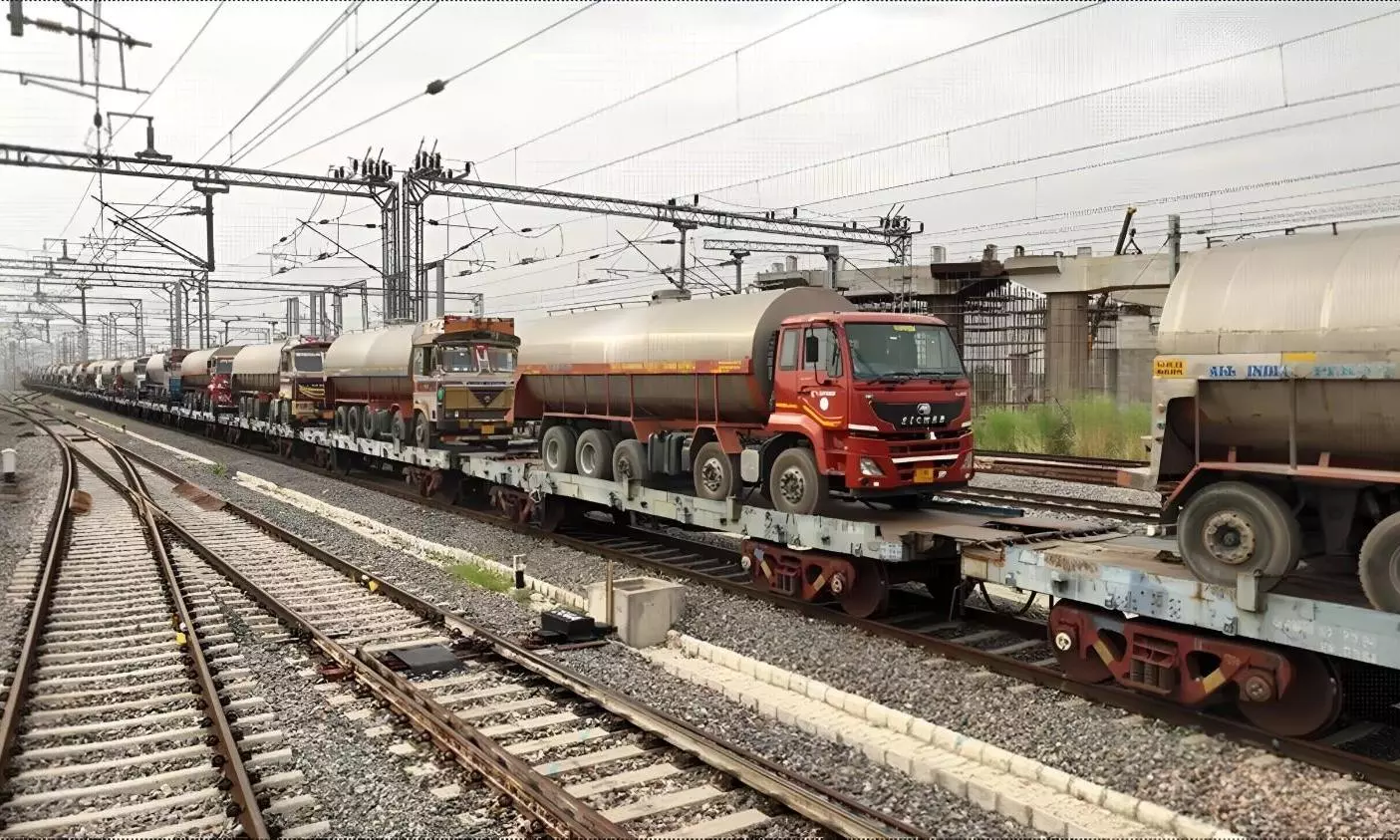


Indian Railways has introduced the Trucks-on-Trains (ToT) service under the Dedicated Freight Corridor (DFC) programme to address rising freight demand and pressure on road infrastructure. The initiative forms part of the long-term freight strategy aimed at improving cargo movement through multimodal integration. The service combines road-based trucking with rail transport to support more efficient long-haul freight movement.
The ToT model enables loaded trucks to be transported on specially designed flat wagons along the DFC. Trucks are moved by rail for the main leg of the journey and use roads only for first and last-mile connectivity. The approach is intended to reduce highway congestion and improve predictability in freight operations.
The service is currently operational between New Rewari and New Palanpur on the Western Dedicated Freight Corridor. Covering a distance of around 636 kilometres, the route has reduced transit time from nearly 30 hours by road to about 12 hours through rail-based movement. The integration of road and rail has helped lower turnaround time and limit exposure to delays associated with long-distance trucking.
Freight is charged based on weight slabs, with rates of ₹25,543 per wagon for trucks up to 25 tonnes, ₹29,191 for loads between 25 and 45 tonnes, and ₹32,000 for loads between 45 and 58 tonnes. Empty trucks are carried at ₹21,894 per wagon. Milk tankers are exempt from GST. Open Indent booking, introduced in January 2024, allows shippers to plan movements in line with operational requirements.
During April to December of FY 2025, the service handled 545 rakes, transporting more than 3 lakh tonnes of cargo and generating revenue of ₹36.95 crore. New Palanpur accounted for 273 rakes and over 2 lakh tonnes of freight, while New Rewari handled 272 rakes and around 1.004 lakh tonnes. The corridor has recorded steady demand from dairy and FMCG segments, supported by regular volumes from Gujarat Cooperative Milk Marketing Federation following a memorandum of understanding signed in June 2023.
The service has supported a shift of long-haul freight from road to rail by moving the longest leg of transport onto electrified corridors. This has reduced highway congestion and fuel consumption while helping transporters avoid toll expenses associated with long-distance road travel. The shift has also improved cost predictability for logistics operators.
Environmental benefits have emerged as a key outcome of the initiative. The electrified corridor lowers emissions associated with freight movement. On the Palanpur to Rewari stretch, nearly 48,875 truck trips are removed from highways, resulting in diesel savings of about 88.81 lakh litres and a reduction of approximately 230.91 lakh kilogrammes of carbon dioxide emissions. The reduction in road traffic has also helped limit dust pollution along major transport routes.
The rail-based model has improved reliability during adverse weather conditions such as fog and heavy rainfall, which often disrupt road transport. By reducing continuous long-haul driving, the service has also contributed to improved road safety and lower driver fatigue.
From a commercial standpoint, Trucks-on-Trains has completed more than 1,955 trips since launch, moved over one million tonnes of freight, and generated cumulative revenue exceeding ₹131 crore. The service has seen participation from sectors including dairy, food processing, automobiles, and consumer goods.
Indian Railways plans to expand the service through the introduction of new flat multipurpose wagons and by adding more origin and destination points across the Dedicated Freight Corridor network. These measures are expected to improve loading efficiency and extend access to additional industrial clusters.
The initiative forms part of the broader multimodal logistics strategy of the Dedicated Freight Corridor Corporation of India Limited, aimed at integrating road and rail transport to improve efficiency, reliability, and sustainability in freight movement across the country.