
NHAI, Rajpath Infracon set Guinness World Records on NH-544G
These records were set on the under-implementation of the Bengaluru–Kadapa–Vijayawada Economic corridor, a 343 km long, access-controlled six-lane highway designed for high-speed travel.
Source X (N Chandrababu Naidu)


The National Highways Authority of India (NHAI), in association with concessionaire Rajpath Infracon, has established four Guinness World Records. The feats were accomplished during the construction of the Bengaluru–Kadapa–Vijayawada Economic Corridor (NH-544G).
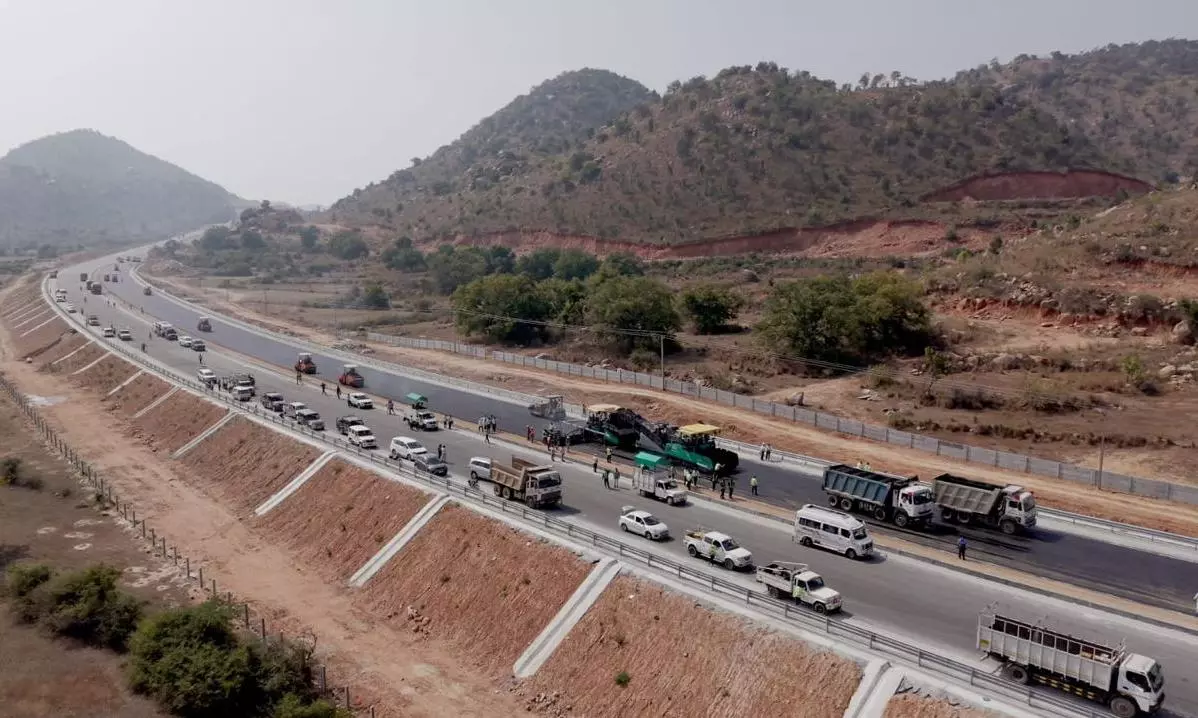
The record-breaking began on January 6, 2026, near Puttaparthi, Andhra Pradesh, where the team established the first two global records. The NHAI achieved the longest continuous laying of Bituminous Concrete in a single day, covering 28.89 lane km (equivalent to a 3-lane wide section stretching 9.63 km) within 24 hours.
Simultaneously, a second record was set for the highest quantity of Bituminous Concrete laid in a single day, totaling 10,655 metric tons. These marked the first time such figures have been recorded globally under a six-lane National Highway project.
The teams returned on January 11, 2026, to secure two additional Guinness World Records across Package-2 and Package-3 of the corridor. These included the continuous laying of a massive 57,500 metric tons of Bituminous Concrete and a record for continuous paving of 156 lane km.
This 156 lane km stretch, equivalent to a 3-lane wide section of 52 km, significantly surpassed the previous world record which stood at 84.4 lane km.
NHAI and Rajpath Infracon deployed a massive fleet of state-of-the-art construction equipment, including 70 tippers, five hot mix plants, one paver, and 17 rollers. The operation was underpinned by stringent quality assurance mechanisms and monitored by premier institutions, including IIT Bombay and original equipment manufacturers (OEMs), ensuring that speed did not compromise safety or quality standards.
These records were set on the under-implementation of the Bengaluru–Kadapa–Vijayawada Economic Corridor, a 343 km long, access-controlled six-lane highway designed for high-speed travel. The project features 17 interchanges, 10 wayside amenities, a 5.3 km tunnel, and a 21 km eco-sensitive section passing through forest areas.
Once operational, the corridor is expected to deliver substantial economic benefits by enhancing regional connectivity between Bengaluru, Vijayawada, the Rayalaseema region, and the Koparthy Industrial Node.
The project will reduce the travel distance between Bengaluru and Vijayawada by 100 km and cut travel time significantly, from the current twelve hours to approximately eight hours.