
The Ease of Doing Business


What makes APM Terminals Inland Services different when it comes to operational performance and customer delight is that the Indian arm of the global multi national corporation is able to leverage global knowledge and best practices from its colleagues from across similar facilities. Customer delight is at the centre of everything they do and they do it with panache. Everyday.
In an industry that’s marred by complexities and dependency on multiple factors, APM Terminals Inland Services, has been persevering and delivering higher standards of operational performance and customer satisfaction year on year. Ever since it was set up with its container freight station (CFS) in Mumbai – the first private sector facility in the region, encouraged by its world class performance it has expanded its operations to inland container depots, empty depots, equipment maintenance & repair and multiple value added services. It has also increased its footprint to key growth centres of India including Chennai, Dadri, Kochi, Tuticorin and Pipavav.
So, what has made it strike the perfect rapport with its customers? There’s no denying that operations is at the heart of a company’s success. And that’s where they have the edge. Having heard loads about their strong operational capabilities and efficiencies across processes, we decided to go deeper to find out what is it that makes them stand out.
Well, first of all, the global lineage that this company carries ensures that it is able to leverage the knowledge of their global colleagues across similar facilities. Having access to the best of Processes, Practices, Equipment and talent pool ensures their customers have access to world-class solutions and services on the local soil. It is also greatly dependant on the ability of the local team to customize the solutions to the requirements of customers. In short, benefits of a global base are immense – higher efficiencies, speedier solutions and on-time performance.
A culture of constant improvement in performance has the employees looking for new avenues and drawing inspiration from the best practices across industries. No wonder, the concept of Customer Service Kiosks which was introduced by the Banking industry a decade ago, was recently introduced in the inland logistics industry by a thoughtful team of people here.
This needs to be delved in a bit more. There was a time when the Customs House Agents (CHAs) visiting CFSs had to stand in long queues at the counter windows for varying requirements - finding out if their container has arrived, where is it stored, making payments, doing the documentation work for customs examination and so on. But not so anymore! Established advanced technologies like Radio Frequency Identification (RFID), were integrated into the Customer Service Kiosks and Token Management System. A visibly simple task – this involves strategic thinking with a long term vision, meticulous planning, thoughtful interface and experience delivery to be addressed through expert operations management. Only when you have a constant conversation within to do something better, can such interesting initiatives transpire. This initiative cut the supply chain timeline for the CHAs by a significant number. Suddenly it was a much more convenient and speedier link in their entire string of activities.
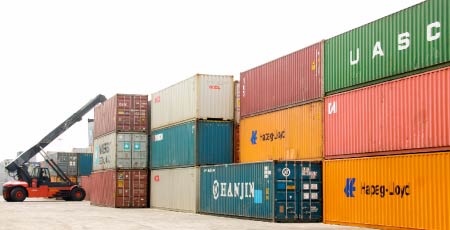
A successful operation is not just about having innovative ideas, but also the capability to effectively execute and sustain them to realize their true potential. The technology of RFID generally found in Terminals was first initiated and successfully implemented in the local environment of APM Terminals Inland Services’ CFSs in India enabling tracking of containers. They also claim to have engineered and implemented the technology at a much lower cost making it far more effective and efficient. This technology saved CHAs the daily turmoil of recklessly looking for their particular containers in a sea of similar looking containers – stacked one over the other.
What’s interesting to know is that the root of this initiative lies in the safety of people. An organization considering safety as their highest priority, they wanted to reduce the man-machine interface in their facilities saving them from any chances of accidents. RFID is key here. The way it works is that containers entering the CFS are assigned with RFID tags and these are tracked to their final location in a yard mapped into zones making it easily traceable and avoiding the need to physically search in the yard.
Having successfully implemented it – they went on to further leverage the technology and weave it into their operations in the yard and their counters cum documentation process. People are today able to easily access the arrival status and exact location of their containers online and on phones. The kiosk mentioned earlier is an extension of the RFID technology.
When we asked Manoj Singh, Head Operations, how does the company measure its operational performance, this is what he revealed - “Safety, absence of accidents and zero Lost Time Injury Frequency , Increased asset and capacity utilization, Reduced Turn Around Time, Cost effectiveness, Process controls, Environment friendly operations and increased convenience”.
What separates them from competition and ensures much smoother operations is, building transparency into their processes. The softer aspects required to operate effectively and efficiently are well addressed. Wrt the trucks entering the facilities to pick up a container, it clearly works on a ‘First-in First-Out’ method. So, while the CHAs are not allowed in the yard, they are all rest assured that the order is being followed.
Inculcating a mindset where the team is able to pre-empt the challenges or demands of a customer has ensured that their operations is geared up to address each requirement/ situation. Being proactive is a quality that is heavily valued here. And there’s proof enough. The ‘Milestone Reporting’ feature - that reaches their customer’s inbox first thing every morning is something that customers swear by. This report includes details and status updates for the container cycle right from the container discharge from port to the cfs, in the stack, in examination for their entire inventory for atleast last 65 days.
At their ICD in Dadri, to ensure a dust and wrinkle free delivery for customers, they have introduced specialized Mobile Garment on Hangers (GOH on wheels) feature enabling easy movement and loading of ready made garments into containers.
“Customer centric to the core. That’s a philosophy they live by. I can see it in the people I interact with. This philosophy brings about so many innovations and initiatives – big and small. Their Milestone reporting feature is what enable us to start our day on a positive note and a step ahead of others - in turn helping us keep our customers ahead” – says Dileep Singh, Vessel Incharge, Samsung India Electronics Pvt. Ltd.
Their evacuation performance from the port is one of the best in the industry. In Mumbai for example, they ensure evacuation by rail link at DRT during road congestion which is frequent. And mind you, there is no bending or breaking of any rules here. Another interesting feature is the Control Room. Military as it may sound, it's a central cell - single point of all information relating to tracking and movement of customer’s container from the port.
As their business and client base kept expanding, a dedicated Customer Service team was introduced to address customer’s requirements and queries relating to status, pendency, charges etc. Today they have a dedicated 24X7 customer care number to address customer’s requirements.
The different functions and sub teams that work in close unison to deliver safe and smooth operations everyday include control room, customer service, gate, export, import, yard, documentation, Maintenance & Repair and Process Excellence (PEX) teams. Process Excellence - In contrast to the norm elsewhere in this industry, the company has a dedicated PEX team focused on continuously evaluating and applying process excellence methodologies leading to higher efficiencies, quicker Turn around Times (TATs), reduced costs and improved performance. The results are commendable and have greatly benefitted the company and its customers. A point in case here is the Six Sigma and Lean Project to increase productivity in the yard at their ICD in Dadri.
Unproductive moves of reach stackers were reduced - delivering 1.25 times productivity through a lower number of reach stackers. Similarly, a pilot lean project in Mumbai has shown promise of 20% reduction in moves and around 40% reduction in TAT for imports. That’s quite a significant figure as the customer stands to gain at the end of it all. Another project in Chennai led to significant reduction in the number of shuffles of containers.
Such methodologies with safety in mind also render new initiatives like Advance grounding and dedicated Examination and De-stuffing (E&D) Zones. As Mr K.Rathnakumar, Director - Paramount Shipping Services Pvt. Ltd. - a leading customs house agent and logistics service provider in Chennai puts it –“I believe the entire CHA community has benefitted from what APM Terminals Inland Services has done with their introduction of advance grounding. By arranging for advance grounding of our containers in the yard, they have freed up more than 50% of our time, cost and effort, saving us from running around in the heat of the day. This has, enabled us to concentrate on delivering better service and transfer operational efficiencies to our customers. Use of technology and common sense in operations can make a huge difference!”
The E&D Zone ensures benefit for the CHAs as their containers for customs examination are pulled out of stacks to a special place and saves them the effort of searching and assigning people saves time and keeps them away from machines in yard – and hence safe. The other stakeholders who also greatly benefit are the Customs Officers coming for inspections. They value the simplicity, and ease of operations. The introduction of dedicated Examination and De-stuffing zones relieved them of having to move from a container in one end of the yard to another for inspections and left them more time at hand to attend to critical matters and increase their productivity.
The other and probably the most interesting and innovative feature is that of Virtual Examination. Amazing way to bring technology to day-to-day business. Here, for green channel containers, the Customs Officer can from the convenience of their cabin view the container, seal number and give clearances. Compare this to the traditional format where the officer has to walk out in the heat of the day multiple times and physically check each container and seal. Now that’s what’s called awesome! With the openness of government officials to adapt to new technologies it’s a great place to be in.
You will always find something different here. At the customer counters, all the windows work as a one stop solution. Only payments have a dedicated counter. The team realized there were cases where a customer’s Demand draft amount fell short of the payable charges, rendering the customer at a loss due to delayed shipment by atleast a day. So, a solution was found and executed by APM Terminals Inland Services proactively – They proposed and tied up with the Customs House Agents Association to enable the CHAs to have credit cards to make payment for shortfalls. That’s called being focused on your customer’s needs.
“We don’t just move boxes. We deliver far more than that. More than constantly creating efficiencies, it’s about making business simpler for all our stakeholders. Safety, innovation, integration and people are the pillars on which we have been able to build such robust and highly efficient operations, structures and systems. Customer centricity lies at the core – always”- says Ajit Venkataraman, Managing Director, APM Terminals India Pvt Ltd.