
Tata Consumer bets on AI to crack the quick-commerce boom
With quick-commerce sales surging, the company is deploying agentic AI through Kinaxis to improve supply-chain efficiency, anticipate demand and ensure faster product availability.
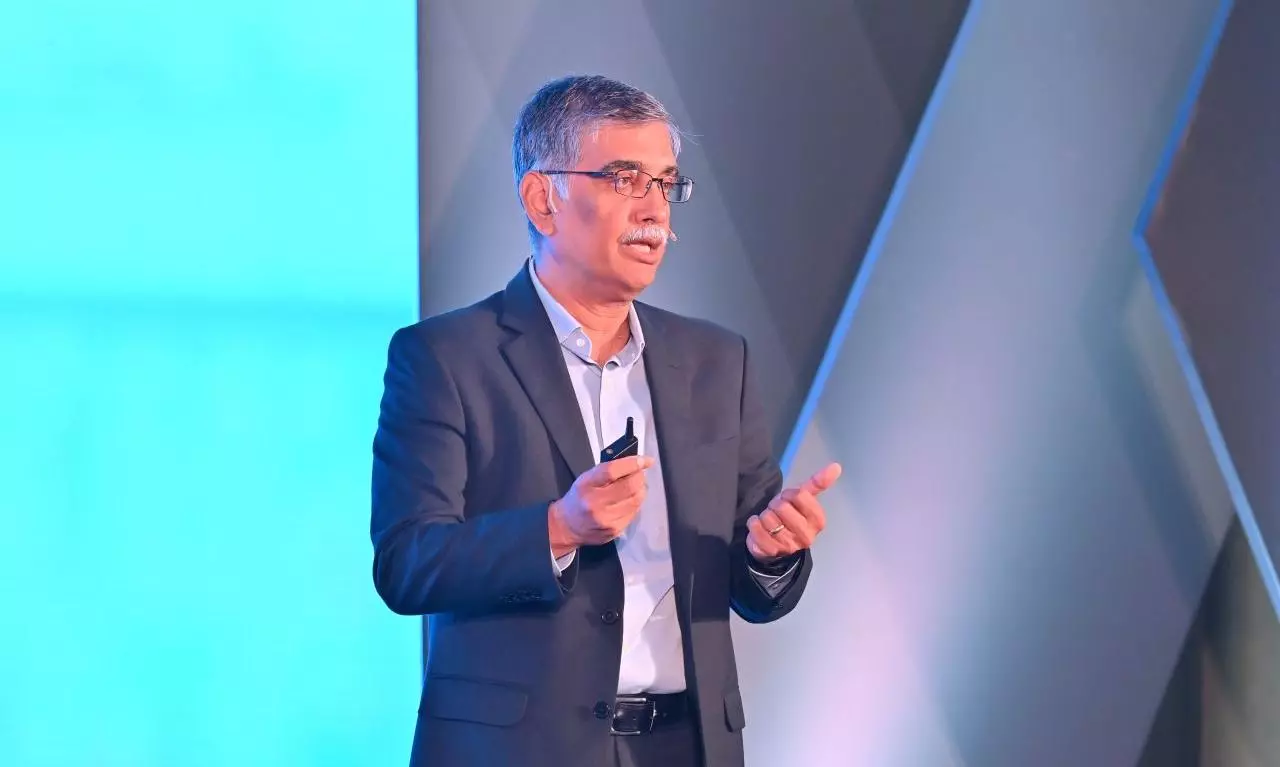
Sunil D'Souza, Managing Director and CEO, Tata Consumer Products


Tata Consumer Products (TCPL) is strengthening its supply-chain planning capabilities through a partnership with Kinaxis as it looks to improve product availability and respond to the growing demands of India's quick-commerce market.
Speaking at Kinaxis' first Kinexions India conference in Mumbai on November 17, Tata Consumer Products managing director and chief executive officer Sunil D'Souza said the company was reworking its supply-chain operations to respond to the shift towards instant commerce and increasingly localised consumer demand.
An integrated food and beverage company, ranked among India's top 10 players in the sector, with ambitions to expand its presence as a multi-category FMCG business, TCPL's quick commerce including e-commerce contributed around 20% of its revenue in FY2026, a share that has continued to increase quarter by quarter, reaching 24% in the most recent quarter (July 1 - September 30).
D'Souza said, "Out of 24% of its business in the previous quarter, quick commerce contributed 21 percentage points and traditional e-commerce remained 3%. Quick commerce therefore represented 87% of the company's online contribution. Its quick-commerce business grew 71% in second quarter, year on year, broadly in line with the 78% growth reported by a leading quick-commerce player in India." He said the shift in consumer behaviour presents both a significant growth opportunity and a supply-chain challenge.
D'Souza added that the company's quick-commerce business grew in last quarter, the shift towards quick commerce is creating additional supply-chain complexities. Demand varies across cities, pin codes, and individual dark stores, while quick-commerce platforms are expanding their product assortments beyond conventional grocery categories.
TCPL has visibility into the mapping between partner Distribution Centres (DCs) and dark stores, as well as orders moving through the network. However, a key information gap remains in tracking product movement between them. To address this, TCPL is using AI agents supported by supply-chain data, ontologies and knowledge graphs to infer, learn and continuously refine visibility of this movement.
To address these requirements, TCPL is moving away from a largely order-led replenishment model towards a demand-sensing approach. D'Souza said the company has named its supply-chain transformation project Astra. The initiative brings together demand and supply planning, product availability and business performance through Kinaxis' connected planning and orchestration capabilities.
The system is designed to consolidate data from across the company's supply chain, identify demand patterns, support decision-making and generate recommendations for planners. Its agentic AI capabilities will help identify availability issues, investigate their underlying causes and recommend corrective actions, while human planners retain responsibility for final decisions.
The system will draw on information from TCP’s warehouses, distribution centres and dark stores, alongside data on product sales and inventory movements. AI agents will analyse gaps in the supply chain, including movements between distribution centres and dark stores, to identify potential reasons for product unavailability. The company is currently running the pilot on a tightly controlled scale, covering 16 products across two categories: Capital Foods and Soulfull. Capital Foods offers products spanning Chinese, Indian and Western street-food formats, while Soulfull focuses on millet-based snacks and breakfast cereals. The pilot is being conducted in two cities, Gurugram and Bengaluru, selected because they are among India's most developed quick-commerce markets.
It is intended to generate weekly customer-level allocation recommendations and identify the root causes of product availability issues. Performance will be assessed through online availability, order fill rates, and the system's ability to balance fluctuations in consumer demand against supply-chain constraints. The company also aims to use planners' feedback and acceptance of AI-generated recommendations to improve the system over time.
The company highlighted dry fruits as an example of how quick commerce can help launch and scale new product categories. Traditionally, selling through retail and modern trade involves sharing a significant portion of the margin with retailers. Quick commerce, however, allows the company to reach consumers directly, giving it greater control over the sales process.
It initially launched its dry-fruit range exclusively online, using the platform to test different product formats, pricing and marketing strategies before scaling up. As demand grew in major quick-commerce markets such as Gurugram, Bengaluru and Hyderabad, traditional retailers also came under pressure to stock the products, as consumers could access them online within minutes. This approach was creating a growth cycle in which products could first be introduced and tested online, refined based on consumer response and then scaled across other sales channels.
Beyond Kinaxis, Tata Consumer Products is building a broader AI and data infrastructure involving SAP, Salesforce, Microsoft and Snowflake. The company is also using Commotion, an AI platform in which Tata Communications acquired a 51% stake, to develop its intelligence layer, including knowledge graphs, AI models and agents.
He added that maintaining product availability at the point of purchase would be critical to competing in quick commerce, where consumers are increasingly likely to switch brands if their preferred products are unavailable.
“Everyone will talk about data. You've got to take decisions based on data. It is not what is based on data. It's going to be based on data, making decisions, getting executed, being trusted by consumers, customers and employees,” said D'Souza.