
Upper Assam sends first river cargo to Bangladesh since 1947
A barge carrying 540 tonnes of methanol has sailed from Bogibeel to Dhaka via the Brahmaputra, reviving a historic trade route.
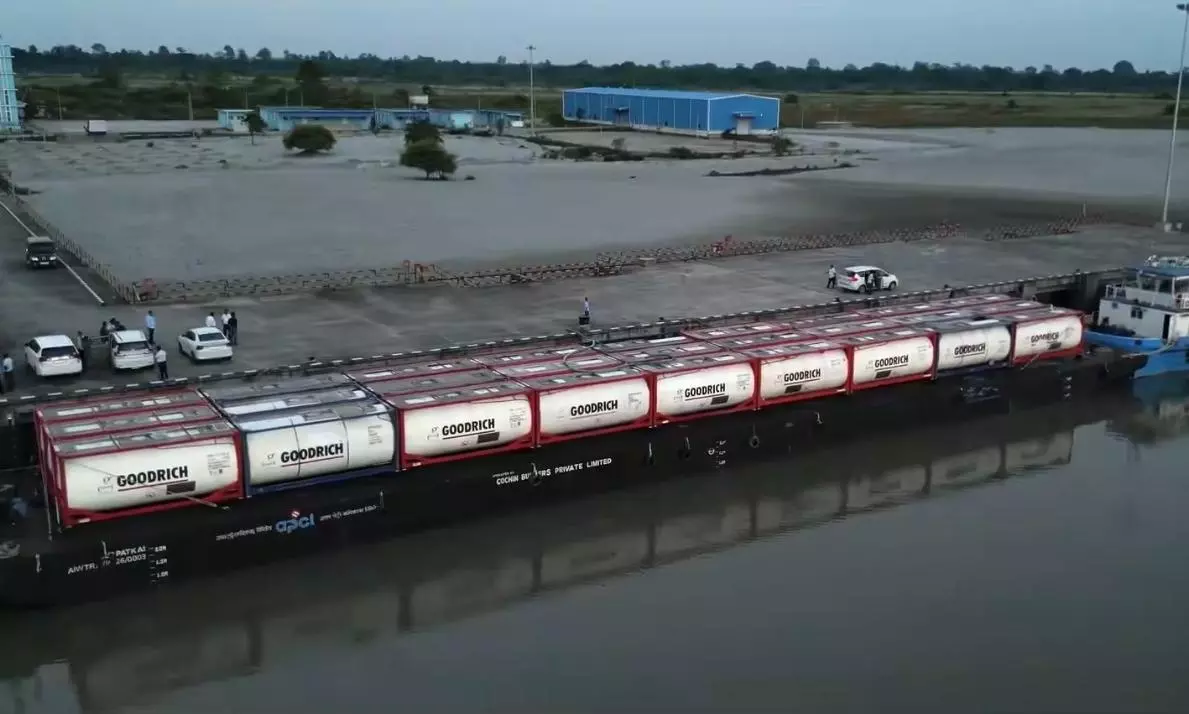


A barge carrying 540 metric tonnes of methanol left Bogibeel Terminal in Dibrugarh, Assam, for Dhaka, Bangladesh, on 5 October, marking the first cargo shipped from upper Assam to a foreign port since India's independence in 1947. Union Minister of Ports, Shipping and Waterways Sarbananda Sonowal flagged off the vessel, DLB Patkai, pushed by the tug Kushal Konwar, with Assam Chief Minister Himanta Biswa Sarma joining the ceremony virtually.
The methanol, produced by state-owned Assam Petro-Chemicals Limited at Namrup, is bound for Pangaon Port in Dhaka. The vessel will travel about 768 kilometres down National Waterway-2 on the Brahmaputra to the Indo-Bangladesh border, before continuing along the Indo-Bangladesh Protocol Route, covering a total distance of 1,300 kilometres from Bogibeel to Narayanganj, Dhaka. The shipment became possible following the recent setting up of customs and immigration complexes at Bogibeel and Dhubri, and regular methanol shipments to Bangladesh are now planned, with the voyage being treated as a test of whether the Brahmaputra can function as a commercially viable freight corridor linking India's Northeast to overseas markets.
Sonowal described the moment as the revival of a route silent for seven decades, recalling that steamers once ran regularly from Dibrugarh before the route fell quiet, and said the shipment marked the beginning of regular voyages rather than a one-off event, framing it as proof the river could again connect the region to the world. Sarma called it a proud day for Assam, saying a product made in Namrup was now reaching international markets via the state's own river, and described the Northeast as no longer a frontier but India's gateway to the East.
Dibrugarh was once among eastern India's busiest river ports, with government steamers reaching the town from Calcutta by 1856, and the Dibru-Sadiya Railway beginning operations from the Dibrugarh steamer ghat in 1882. By 1913, steamers sailed up the Brahmaputra to the town daily, carrying tea, timber and passengers. That trade was disrupted by the 1947 partition, which cut off the route to Calcutta through what became East Pakistan, and further affected by a 1950 earthquake that disturbed the riverbed at Dibrugarh. Regular bookings from the ghat stopped in 1954, and it closed entirely on 15 October 1956 as tea shipments moved to rail. The 1965 India-Pakistan war suspended cross-border river trade altogether.
India and Bangladesh signed a river trade protocol in 1972, and in 1988 the 891-kilometre stretch of the Brahmaputra from Sadiya to Dhubri was declared National Waterway-2, though regular cargo service did not resume until December 2017, when cement began moving from Pandu to Dhubri. Activity on the route has since grown: Tata Steel barges reached Pandu via Bangladesh in February 2022, the river cruise ship MV Ganga Vilas sailed from Varanasi to Dibrugarh through Bangladesh in 2023, the Bogibeel passenger and cargo terminal opened in February 2024 after its foundation stone was laid in July 2023, and the Jalvahak cargo incentive programme launched in December 2024.
According to the Ministry of Ports, Shipping and Waterways, cargo movement on India's national waterways rose from 18 million metric tonnes in 2013-14 to 218 million metric tonnes in 2025-26. More than ₹6,800 crore, around 770 million US dollars, is being invested in waterways infrastructure across the Northeast, including further development of National Waterway-2, a ship repair facility at Pandu, and last-mile connectivity to Pandu Port. Sonowal said India was also working with Bangladesh, Nepal, Bhutan and Myanmar on regional waterway links, and noted that every tonne of cargo moved by river meant less fuel burnt and fewer trucks on the highway.
The voyage involved the Inland Waterways Authority of India, Assam Petro-Chemicals, Cochin Bunkers and partners in Bangladesh. Assam ministers Charan Boro, Bimal Borah and Sushanta Borgohain attended the ceremony, along with Rajya Sabha member Terash Gowalla, Dibrugarh MLA Prasanta Phukan, Khowang MLA Chakradhar Gogoi, IWAI chief engineer A K Bansal, and APCL chairman Bikul Ch Deka.