
Inside India’s push to build, own, finance more ships
With the government pushing toward shipbuilding, vessel ownership, maritime finance and over the country’s trade routes, Indian maritime is entering a new phase.
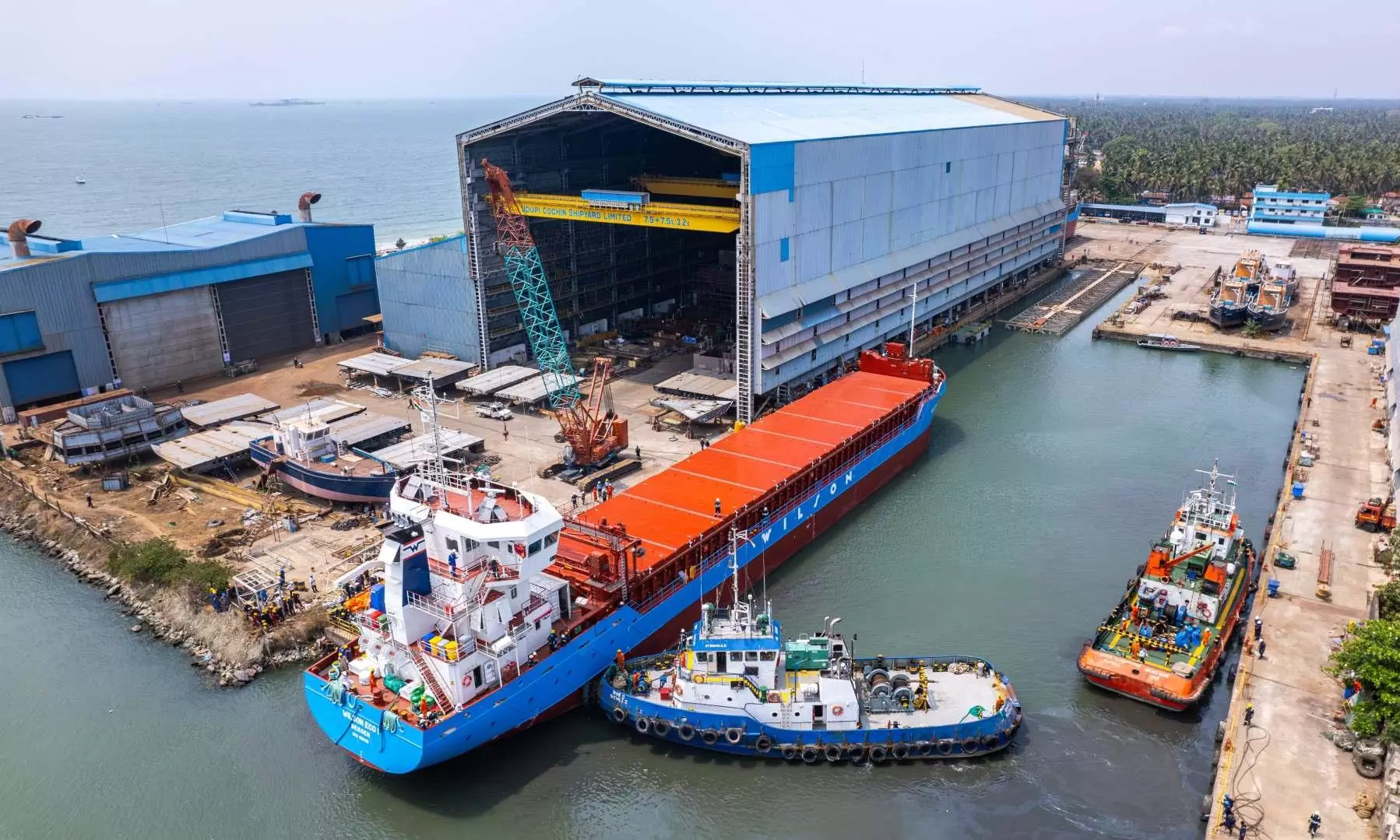
Udupi Cochin Shipyard, a subsidiary of Cochin Shipyard, in April 2025 launching Wilson Eco I, the first of the six 3800 TDW dry cargo vessels it contracted to build for Norway-based Wilson ASA.


For decades, India’s maritime ambitions largely revolved around ports, privatisation, cargo handling, and logistics corridors. Now, the conversation is shifting toward something deeper: building ships, owning ships, financing ships, manufacturing containers, strengthening coastal shipping and creating a maritime ecosystem that reduces dependence on foreign fleets.
For instance, in 2023, the government unveiled the Maritime Amrit Kaal Vision 2047, a long-term blueprint aimed at turning India into one of the world’s top five shipbuilding nations and expanding domestic shipbuilding capacity to around 4.5 million gross tonnes (GT) from the current 0.072 million GT. In the 2025 Union Budget, Finance Minister Nirmala Sitharaman announced a ₹250 billion Maritime Development Fund to ease long-term financing constraints for shipbuilders, shipowners, and maritime infrastructure projects, alongside customs duty exemptions and incentives for shipbuilding and recycling. Later in September 2025, the Union Cabinet approved a broader ₹697 billion maritime package built around four pillars: the Shipbuilding Financial Assistance Scheme, the Shipbuilding Development Scheme, greenfield and brownfield shipyard expansion, and skilling and ecosystem development.
Aerial view of Cochin Shipyard at Ernakulam, Kerala
The Q4 & full year FY26 earnings conference call of Shipping Corporation of India (SCI) in May 2026 offers perhaps the clearest indication yet that India is attempting to build an integrated maritime ecosystem spanning vessel ownership, shipbuilding, container shipping, insurance, energy logistics, and strategic fleet capacity.
Increasingly, the initiatives are being presented as a matter of economic sovereignty and national security. “There are two clear-cut priorities for the Government of India,” said SCI Chairman and Managing Director B.K. Tyagi during the call. “One is to have the ship construction now done in India, especially the commercial big vessels. Parallelly, that Indian tonnage should increase.”
SCI is the country’s largest state-owned shipping company, currently operating a fleet of 58 vessels, including tankers, bulk carriers, container ships, and gas carriers. It is also a key partner in the Bharat Container Shipping Line (BCSL) joint venture alongside Container Corporation of India, Jawaharlal Nehru Port Authority (JNPA), V.O. Chidambarnar Port Authority (VOC Port), Chennai Port Authority (CPA), and Sagarmala Finance Corporation (SMFCL).
“Currently, the Indian container fleet is as good as negligible,” Tyagi said. He further disclosed that around 51 vessels have already been identified under a long-term demand aggregation plan extending up to 2047. In fact, SCI plans to acquire 216 vessels by 2047 through an estimated ₹1 trillion investment programme, including 59 vessels under oil and gas demand aggregation, 51 vessels under the BCSL initiative, and additional fleet expansion through SCI and future joint ventures.
“There are two clear-cut priorities for the Government of India. One is to have the ship construction now done in India, especially the commercial big vessels. Parallelly, that Indian tonnage should increase.”
B.K. Tyagi, Shipping Corporation of India
Structural change that was long overdue
Perhaps the clearest indication that the maritime ownership narrative is beginning to translate into action came when Pushpank Kaushik, Chief Executive Officer of Jassper Shipping, spoke about his own company’s plans. Jassper Shipping is preparing to enter vessel ownership. “We are already in talks of owning a ship ourselves,” he revealed. “Maybe in the next 12 to 14 months, we will be one of the very few Indian companies to own a bulk carrier with an Indian flag.”
According to Kaushik, the policy shift is a correction that India should have pursued years ago. “This is long overdue,” he said. “This should have happened maybe three or four decades ago.” His argument is simple: a modern economic power cannot remain dependent on foreign-controlled commercial fleets while aspiring to become a global manufacturing and trading hub.
That thinking has gained urgency amid ongoing geopolitical tensions. Kaushik pointed to the recent instability in the Middle East to explain how vessel ownership is tied to national sovereignty and cargo security. “If it is an Indian vessel, it was not attacked,” he said, referring to recent disruptions in the region. “But if it is a European vessel with an Indian crew, it would not make a difference.”
This marks a structural change in how India views the maritime sector itself. According to Naveen Prakash, Director of Global Logistics Solutions, “India has started looking at maritime not just as transportation infrastructure, but as a strategic economic and geopolitical ecosystem.”
Exposed vulnerabilities
That shift has been accelerated by a combination of geopolitical disruptions, supply chain vulnerabilities exposed during the pandemic, and India’s own trade ambitions. India already handles nearly 95% of its trade volume by sea, yet Indian-owned ships still transport only a limited share of that cargo. The result is a significant outflow of freight earnings to foreign shipping companies.
Prakash points out that this vulnerability became particularly visible during the Covid-19 pandemic period, when container shortages, vessel availability, and soaring freight rates transformed shipping from a commercial issue into a strategic one.
According to a senior logistics industry veteran with experience at global firms including DP World and DHL, the shocks of the Covid era fundamentally changed how policymakers viewed shipping, vessel ownership and strategic autonomy. The executive, who recently stepped away from the industry after nearly three decades in logistics and requested anonymity because he is currently on sabbatical, said the pandemic exposed India’s vulnerability in global shipping. Freight rates exploded, exporters struggled, and the country realised how little control it had over the movement of its own trade.
“We had a shortage of ships calling India,” he said. “If a box moving from here to Europe was $1,000, it suddenly became six or $7,000. Exporters started complaining. Sometimes the freight rates exceeded the value of the cargo.”
That experience, he argued, transformed shipping from a commercial issue into one of strategic significance. India’s growing emphasis on ship ownership, cabotage, transhipment infrastructure and national carriers is therefore tied to a broader geopolitical calculation. “I guess the government realised that this is not just a question of business,” he said. “It is a question of geopolitical significance and of strategic autonomy as well.”
For instance, the theme running through the Q4 & full year FY26 results conference call of The Great Eastern Shipping Company (GE Shipping) in May 2026 was how quickly global shipping dynamics changed after disruptions around the Strait of Hormuz.
“Ship owning depends heavily on long-term demand visibility and availability of low-cost capital. Indian businesses traditionally remain cautious because shipping is an extremely cyclical industry with sharp peaks and downturns.”
Naveen Prakash, Global Logistics Solutions
Learnings from Strait of Hormuz
GE Shipping, India’s largest private sector shipping company, operates a fleet of about 39 vessels aggregating more than 3.1 million Deadweight Tonnage (DWT), including crude tankers, product tankers, LPG carriers and dry bulk vessels, along with an offshore business.
According to G. Shivakumar, Executive Director and Chief Financial Officer of GE Shipping, tanker markets were already firm before the crisis, but the disruption dramatically amplified freight demand. “Because of the scramble to source oil cargoes from wherever they were available, we saw a lot of long-haul trades replacing the Middle East to Asia trades,” Shivakumar said. “And that resulted in a big spike in demand for ships and, therefore, a big spike in the freight rates.”
The implications go far beyond freight earnings. When cargoes move longer distances, ships stay occupied for longer periods. That tightens effective vessel availability worldwide even if the total fleet size remains unchanged. Despite rising vessel orders, GE Shipping executives stressed that global shipbuilding capacity itself has not expanded significantly. “The yard capacity has not grown that much. It’s just that the slots are getting filled up,” Shivakumar said.
For several years, many large shipyard slots were occupied by container ships and LNG carriers. Now crude tanker orders are beginning to reclaim those slots. But delivery timelines remain stretched. “If you probably need [a ship] now, you will probably get a ship in 2029,” Shivakumar remarked. That statement alone captures why countries worldwide are beginning to view shipbuilding capacity through a strategic lens rather than merely an industrial one.
Interestingly, even amid elevated freight markets, GE Shipping’s management sounded notably conservative about expansion. The company repeatedly stressed that it is largely replacing older vessels rather than aggressively growing fleet size. “Replacing, we will continue to do. Increasing, we will not do for current yield,” Shivakumar said.
The caution is rooted in shipping’s brutal historical cycles. “Current yield is a bit of a trap,” Shivakumar warned. This mindset highlights a challenge India may face in its maritime ambitions: even if policymakers want rapid fleet expansion, private shipowners may remain reluctant.
“The hub-and-spoke model is extremely relevant for India. It makes more operational efficiency for smaller ports to send cargo to a mother port, and then a mother vessel can just come, pick them up and take them out.”
Tej Contractor, FIATA
Foreign exchange outflow in freight
India’s simultaneous push toward shipbuilding, ship repair, coastal shipping, container manufacturing, and maritime financing is often described as industrial policy. But Prakash argues the rationale goes deeper. “They are directly linked to the country’s foreign exchange outflow.” India continues to spend billions of dollars externally on freight payments, ship leasing, repairs, and container procurement. Building domestic capabilities in these sectors is therefore as much about macroeconomic resilience as industrial development.
“Today we are basically nearly $80 billion going out of the country in terms of freight,” Tyagi of SCI said during the earnings conference call. That figure is increasingly shaping India’s shipping policy. The government and public sector players now appear focused on retaining a larger share of freight earnings within the country instead of depending heavily on foreign shipowners for transporting Indian cargo.
Yet despite the ambition, Prakash cautions that execution will be far more difficult than policy announcements suggest. “Ship owning, just like any heavy infrastructure business, depends heavily on long-term demand visibility and availability of low-cost capital,” he explains. “Indian businesses traditionally remain cautious because shipping is an extremely cyclical industry with sharp peaks and downturns.” That caution is shaping where Indian participation is emerging today.
Aerial view of Swan Defence and Heavy Industries' shipyard at Pipavav, Gujarat.
Financing as the missing piece
While India has spent years discussing shipbuilding ambitions, Kaushik believes the real bottleneck was never the physical construction of ships. “The most important part was finance.”
For years, Indian shipping companies struggled because ships were not clearly recognised as enforceable collateral under the Securitisation and Reconstruction of Financial Assets and Enforcement of Security Interest (SARFAESI) Act, 2002 framework. As a result, banks demanded double-layered security. “If you wanted to own a ship and take finance from the bank, you needed to give 100% collateral in any other security, like a building or land, and then the ship also goes into collateral.”
Kaushik explained. “So for ₹1 billion of loan, you need to give ₹2 billion of collateral.” That equation made vessel ownership commercially impractical for many Indian firms, particularly when compared with maritime economies such as Singapore, China, Norway, or Denmark, where specialised shipping finance ecosystems already exist.
Kaushik said the recent regulatory changes allowing ships themselves to be treated as collateral could fundamentally alter the market. “Now banks are eligible to give loans on ships by taking only ships as collateral,” he said. The impact, according to him, is already visible. “We are seeing a lot of new inquiries, new business plans being set up by Indian companies to own vessels.”
He identified the State Bank of India, EXIM Bank, and Asian Development Bank as institutions showing active interest in ship finance. India’s ambitions are also being supported by the rise of Gujarat International Finance Tec-City (GIFT City) as a financial and leasing hub. Kaushik said tax incentives and operational advantages available through GIFT City are beginning to attract maritime businesses, including ship brokers and vessel operators.
“I don’t think we need to involve foreign carriers in coastal shipping. We already have very strong regulations wherein a foreign carrier needs to convert its flag to the Indian flag for that very moment and follow certain norms.”
Pushpank Kaushik, Jassper Shipping
India’s balancing act on cabotage
As India pushes projects such as Vizhinjam International Seaport (VISL) to emerge as global transhipment hubs, policymakers are also trying to recalibrate the country’s relationship with foreign shipping lines. One of the biggest debates now shaping Indian maritime policy is how aggressively the country should restrict foreign carriers in coastal shipping while simultaneously trying to develop itself as a global transhipment hub.
Traditionally, cabotage rules reserved coastal cargo movement between Indian ports for Indian-flagged vessels. However, in 2018, the government relaxed these restrictions for foreign container ships in a bid to promote transhipment and reduce India’s dependence on hubs such as Colombo, Singapore and Dubai. The liberalisation became particularly important for the rise of VISL, whose rapid growth has been driven largely by the global liner major Mediterranean Shipping Company (MSC) and its feeder network.
In early 2026, however, the Ministry of Ports, Shipping and Waterways (MoPSW) withdrew key 2018 exemptions, signalling a renewed push to protect Indian shipping interests and encourage domestic vessel ownership. The move triggered concern from MSC, which reportedly warned that stricter cabotage enforcement could weaken Vizhinjam’s competitiveness as a transhipment hub. In March 2026, MoPSW extended the transition period for the withdrawn cabotage relaxations by another six months, effectively postponing stricter enforcement until at least October 2026.
Kaushik argued that the government understands the strategic importance of global liner companies, which collectively dominate world trade. “There are hardly four liner groups controlling the entire market, and they control about 80% of the trade,” he said. Yet Kaushik does not support a complete opening of coastal shipping to foreign carriers. Instead, he favours the approach that prioritises Indian operators while allowing foreign participation only when required.“I don’t think we need to involve foreign carriers. We already have very strong regulations wherein a foreign carrier needs to convert its flag to the Indian flag for that very moment and follow certain norms.”
However, the logistics veteran believes the timing may not yet be right for protectionism. “India’s focus has to be on developing ports.” He argued that global container shipping has become highly consolidated over the last two decades, with even major economies lacking strong domestic liner operators. The United States, for example, remains a dominant trading nation despite having no major container carrier among the world’s top operators.
Instead of restricting foreign participation prematurely, he believes India should prioritise deeper drafts, larger berths and world-class infrastructure that can attract global shipping lines organically. “The big shipping lines will come only if they have the flexibility to move cargo between Indian ports,” he said. “MSC would be interested in Vizhinjam only if they can move cargo from neighbouring ports into Vizhinjam at their convenience.”
Tej Contractor, Vice President at The International Federation of Freight Forwarders Associations (FIATA), believes the answer lies in balance rather than protectionism. “While we protect our Indian shipping industry, we also have to have a balance between the two,” he said. “Currently, India is dominated by businesses that move through foreign shipping lines.” He warned that India’s dependence on foreign carriers creates strategic vulnerability. A withdrawal by even a few major global shipping lines could severely disrupt export-import capacity into and out of the country.
At the same time, Contractor argued that allowing flexible coastal operations can actually strengthen India’s logistics competitiveness rather than weaken domestic players. He pointed to successful regional shipping models in Europe, Indonesia and the Gulf, where smaller feeder and coastal services complement larger mainline operations. “The hub-and-spoke model is extremely relevant,” he explained. “It makes more operational efficiency for smaller ports to send cargo to a mother port, and then a mother vessel can just come, pick them up and take them out.”
As global supply chains grow more uncertain and shipping becomes increasingly tied to economic security, India’s maritime ambitions are about controlling the ships, capital and infrastructure that move the nation itself. But building a globally competitive shipping ecosystem will likely require years of sustained investment, regulatory stability and industry participation.
This article was originally published in the Indian Transport & Logistics News' May-June 2026 issue.