
Hapag-Lloyd commits to invest ₹20,000 crore in India
Hapag-Lloyd plans to reflag up to four vessels under the Indian flag, support a sustainable ship recycling ecosystem and invest in infrastructure development at Vadhavan Port.
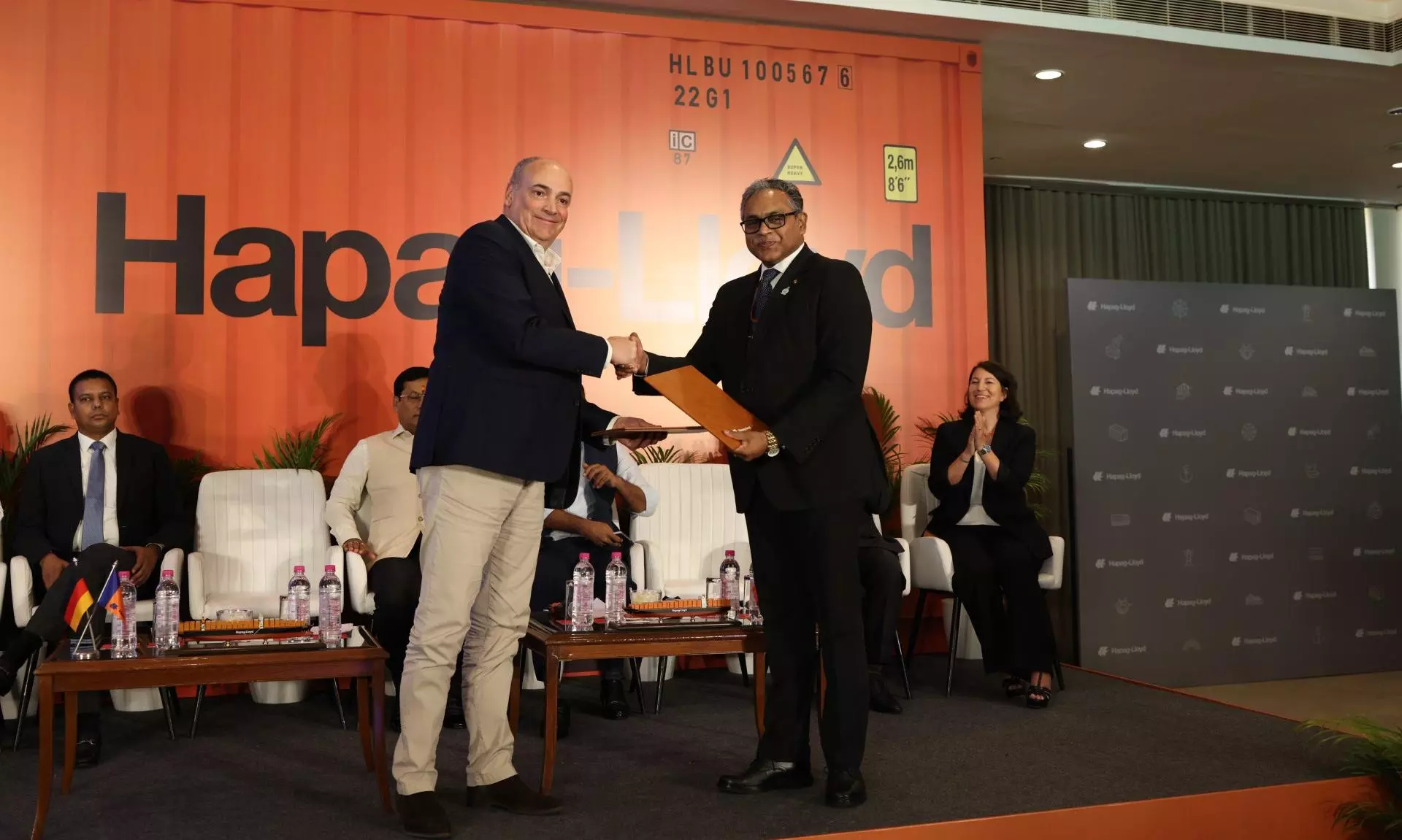
(L-R) Rolf Habben Jansen, Chief Executive Officer of Hapag–Lloyd, exchanging MoU for vessel reflagging with Shyam Jagannathan, Director General of Shipping, in the presence of Sarbananda Sonowal, Union Minister for the Ministry of Ports, Shipping and Waterways (MoPSW), at the announcement held in Mumbai on March 19, 2026.


The world’s fifth-largest container shipping company, Hapag-Lloyd and the Government of India have signed a Letter of Intent (LOI) to deepen maritime cooperation, and the German firm committed to invest nearly ₹20,000 crore in the country across three initiatives, including reflagging vessels, development of a ship recycling ecosystem and infrastructure at Vadhavan Port.
“Hapag-Lloyd has been a valued partner in India’s maritime journey for over five decades,” says Sarbananda Sonowal, Union Minister, Ministry of Ports, Shipping and Waterways (MoPSW), during the announcement. “Hapag-Lloyd offers connectivity across more than 70 countries for India and handles over 1.9 million TEUs annually in India,” he points out.
According to the minister, this reflects the confidence Hapag-Lloyd places in India. “Your existing investment of over ₹6,000 crore, along with a broader commitment of nearly ₹20,000 crore, underlines a deep and long-term strategic alignment with India’s development vision,” he added.
As Hapag-Lloyd Chief Executive Officer Rolf Habben Jansen puts it, the real story lies in the scale of what’s coming next in India. “Container volumes in India, currently around 20–25 million TEUs, are expected to at least double over the next 10–15 years,” he said in Mumbai during the announcement.
Hapag-Lloyd has more than 2,800 employees in India across four business units, making Indians one of the largest nationalities within the company. With 17 offices in India, it offers 6 dedicated liner services connecting India to major global trade lanes.
Earlier in 2023, Hapag-Lloyd AG acquired a 35 percent stake in the Indian private terminal operator JM Baxi Ports & Logistics and subsequently increased it to 40 percent through a capital infusion. J M Baxi operates container terminals, inland container depots, container freight stations and rail services across the country, employing around 7,000 people and handling approximately 3.2 million TEU annually.
As part of its Strategy 2030, Hapag-Lloyd aims to grow volumes handled in India to around 3 million TEU by 2030.
Hapag-Lloyd intends to contribute its global shipping and terminal expertise to the development of Vadhavan Port in collaboration with the Jawaharlal Nehru Port Authority (JNPA), as part of the LOI. “We are very much prepared to continue to invest in Indian infrastructure,” Jansen says, pointing to projects like Vadhvan as part of that commitment. “The infrastructure developments will be through Hanseatic Global Terminals and partners like JM Baxi,” he clarifies.
“India’s port and logistics infrastructure is developing at remarkable speed and scale,” said Dheeraj Bhatia, CEO of Hanseatic Global Terminals and member of the Hapag-Lloyd Executive Board. “Projects such as Vadhavan Port have the potential to strengthen India’s role in global supply chains. We look forward to helping develop an efficient, future-ready port infrastructure in India.”
The LOI also includes cooperation on the development of a ship recycling ecosystem in India. For Jansen, the opportunity sits in a part of the value chain that is often overlooked. “If you look at the global fleet today, it is starting to age, which means over the next five, 15 and even 25 years, there will be an increased need to recycle ships,” he says.
The constraint, however, is structural. “There is not enough capacity globally to do this in a way that is acceptable internationally.” That gap, he believes, is where India can step in. “We believe we can help create that in India, and it could be a great business opportunity because the market is definitely there.”
The envisioned ecosystem could provide capacity for recycling up to 100 vessels. Beyond recycling, he points to a broader industrial ripple effect. “Once we recycle ships, the steel becomes available, which can be used to build new ships or even containers,” he adds, hinting at an ecosystem that could grow around it.
As part of the LOI, Hapag-Lloyd intends to explore the reflagging of up to four vessels under the Indian registry. For Jansen, the commitment also takes a more symbolic and structural form. “The Indian market is important to us. We see significant coastal traffic and already have a large number of Indian seafarers,” he says. That linkage is now translating into action. “We will commit to reflag, at least initially, up to four vessels under the Indian flag.”
The move, he suggests, goes beyond compliance. “We believe this will help strengthen India’s maritime ecosystem. It is a sign of our trust in India, but also a long-term commitment to its vision of building a stronger shipping industry,” he adds, pointing to the potential for more jobs and opportunities for Indian maritime talent.