
Setting the trend: Converting industry’s waste to gold


This article brings forth the oft unspoken aspect of the trade and logistics industry - especially where there is perishable cargo involved. As we are witnessing, with a shrinking world and an expanding economic growth, the amount of perishable products being made available from the deepest pockets of hinterlands to the entire world has significantly increased.
One of the closest though not complete indicator of trade of perishable cargo is reefer trade. As per one of Drewry’s latest Reefer Shipping Market Annual Review and Forecast, the Reefer container shipping fleet has increased by 15 percent year on year and could grow as much as 20 percent by 2018. Seabury statistics indicate that India is becoming a hotspot for seaborne perishable cargo. A report by TechSea Research ‘India Cold Chain Market Forecast Opportunities’, the cold chain market of India is anticipated to grow at the compounded annual growth rate of 28 percent during 2012-17, which will make it a whooping $11.6 Bn (Rs 6400 Crore) market. All simply indicating the exponential growth India’s reefer trade (perishable commodities) will witness in the years to come. Having said that, where there are perishables, there are far more nuances involved with respect to the trade industry – most critical being ensuring cargo is unexpired and consumed while its freshness is maintained. If supply chain is not managed, it could be big trouble.
When a customer abandons container with perishable cargo Coming down to the real life situation, that’s what happens when a container arrives in a Container Freight Station (CFS) or Inland Container Depot (ICD) and is abandoned by the consignee (CFSs/ICDs witness abandoned cargo on a regular basis). The industry faces multiple cases annually where the cargo is abandoned by consignees due to reasons like the container being stuck in customs formalities, receipt of cargo in non-usable condition, rejection of export cargo and wrong declaration– to state a few common ones. In each of these cases the CFS is stuck with perishable material which is mostly unusable and needs to be dealt with at the CFS's expense – even though it has no role to play in it. Let’s take some examples of such products – fruits, vegetables, chocolates, nuts, spices, meat, milk, beverages. Imagine these are lying in a container for days or months - far beyond their shelf life. If not attended to well in time, the same would start rotting, giving away foul smell and posing environmental and human hazard in the future. CFSs/ICDs are forced to keep the content refrigerated even though they are not usable. The standard procedure of dealing with such cargo as laid down by authorities is that of incineration. Incineration is a process whereby the bio degradable cargo is burnt in an incineration plant. What’s notable is that while the machine has a filter for gases, it cannot completely restrict the release of these gases into the environment – a major component being carbon dioxide. Incineration can only be done in a facility as approved by Pollution Control Board and in Mumbai there is only one such approved facility available. So, the cargo needs to be transported to such a facility entailing use of additional time, effort and resources. In search of a new solution In a chat, the team at APM Terminals Inland Services, South Asia shared with us a new initiative – a first for the industry and a boon for the environment. Here’s an account of the initiative – from genesis to fruition. Not only is it interesting, but also truly an eye opener.
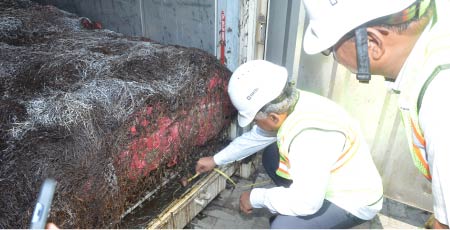
The Answer: Collaboration between Business and Science In pursuit of a far more operationally efficient and environment friendly method of dealing with execution of abandoned perishable cargo, the APM Terminals Inland Services’ Auctions Team in Mumbai brainstormed and decided to approach the Nuclear, Agriculture and Biotechnology Division at Bhabha Atomic Research Centre (BARC) to seek advice and guidance. Dr Sukhendu Ghosh, Scientific Officer of the department was the first contact point and he helped the team connect with Outstanding Scientist and Padma Shri – Dr Sharad Kale who heads the Nuclear, Agriculture and Biotechnology Division at Bhabha Atomic Research Centre (BARC) in Mumbai. Dr Sharad Kale honored with the title of Padma Shri, is a passionate scientist committed to the cause of environment. When he was approached for an in-situ biodegradation solution for dealing with abandoned perishable cargo in containers, he and Dr Ghosh happily and instantly agreed to help out pro-bono! Dr Kale developed an inoculum (a culture composed of multiple kinds of bacteria) that when introduced in existing biodegradable material (the container with perishable cargo in this case) enables natural decomposition of the cargo with organic manure as the end product. This process through bio assimilation doesn’t just help retain micronutrients and trace elements (e.g. B,Cu,Zn,Mg,Fe etc) in the active eco system, but also prevents Carbon Dioxide emission in the atmosphere. This process is called in-situ biodegradation and is completed in a comparatively much shorter span of time. From what APM Terminals Inland Services’ team shares, Dr Kale and Dr Ghosh’s sense of commitment, selfless investment of time, support and rich guidance at every step are far beyond commendable. The duo even made frequent visits to the company’s Mumbai facility to monitor the progress. Follow the trail Ever since the idea of application of in situ biodegradation popped up in the team’s mind, it was an effort intensive time span of close to seven months, before the first container containing potatoes was subject to this process. Concept discussions with Dr Kale, were followed by inspection visit from Dr Kale and Dr Ghosh to APM Terminals Inland Services’ CFS facility in Nhava Sheva, Mumbai. Post the go ahead received from the BARC duo, APM Terminals Inland Services approached the Customs department with the concept and received an in principle approval subject to NOC from local authorities and police. The team steered ahead and obtained No Objection Certificates from CIDCO and the Police. With their forward thinking approach, the team also connected with various organizations for effective disposal / distribution of manure (the end product of the in situ biodegradation process). And well, they found their takers very close by – Jawaharlal Nehru Port Trust (JNPT) agreed to accept the resultant manure. The real action started when Dr Kale shared a laboratory grown bacterial and fungal consortium (inoculum) which was manually added in the containers carrying stale perishable cargo. This inoculum, in presence of fresh oxygen from air starts the decomposition process. In order to expedite the process and provide additional oxygen, industrial fans were put to use. With regular manual mixing of waste and inoculums, and monitoring, cargo in one container can be treated in as less as 7 – 10 days. "As an organization committed to trade and environment equally, we constantly endeavor to pursue initiatives aimed at enriching the environment. This initiative is a beautiful example of collaboration between the government and organizations and the treasure house of talented stalwarts like Dr Kale, and we are extremely thankful to them. It has been a wonderful opportunity to make a fruitful contribution to our members in the industry and the environment," says Ajit Venkataraman, MD, APM Terminals India Pvt Ltd.
And it bears fruit! This first-of its-kind experiment saw success when seven containers carrying 200 MT of stale potatoes underwent the in-situ biodegradation process and APM Terminals Inland Services was able to generate 44 MT of rich organic manure in a matter of less than a month. Some of it was distributed to neighboring CFSs to be used as culture to enable biodegradation of such perishable cargo in their long standing containers. The rest is being sent to JNPT for use in the green spaces.
The highlight While this process has been found to be used in other areas, this is for the first time that it is being used in the container logistics industry and most importantly as an in-situ (biodegradation within the container) process. This initiative drastically changes the way abandoned containers with perishables will be managed in the future and the impact on the environment. Simply put, this is a process of effective waste management. Not just setting the trend for the company but the entire fraternity Having tasted success in this initiative, APM Terminals Inland Services’ Mumbai team went ahead and worked with the Customs Department to define the Standard Operating Procedures (SOP) and finalize the process. A seminar aimed at educating the CFS fraternity on the process of in-situ biodegradation during meetings of the Container Freight Stations Association of India (CFSAI) was held. The same was also discussed during Customs Task Force Meetings - monthly meetings of Customs focused on disposal of containers. With more than 30 Container Freight Stations in Nhava Sheva itself, this process of in-situ biodegradation holds great promise for the companies and the environment. Padma Shri Dr Kale expresses with great passion, "The word waste doesn’t exist in the dictionary of nature. It only exists in our dictionary as human beings. Waste is simply a resource that’s probably not needed by us at that moment but is definitely a part of the cycle somewhere else. Burning breaks the cycle. The moment one understands that waste is actually a resource and they are both two sides of the same coin, we will understand that it is actually valuable. It’s a natural resource and its gold!"