
Indian logistics looks to rail for more reliable cargo movement
At IICS 2026 Delhi, industry leaders said India must move beyond capacity building to fix predictability, cost and coordination in inland cargo flows.
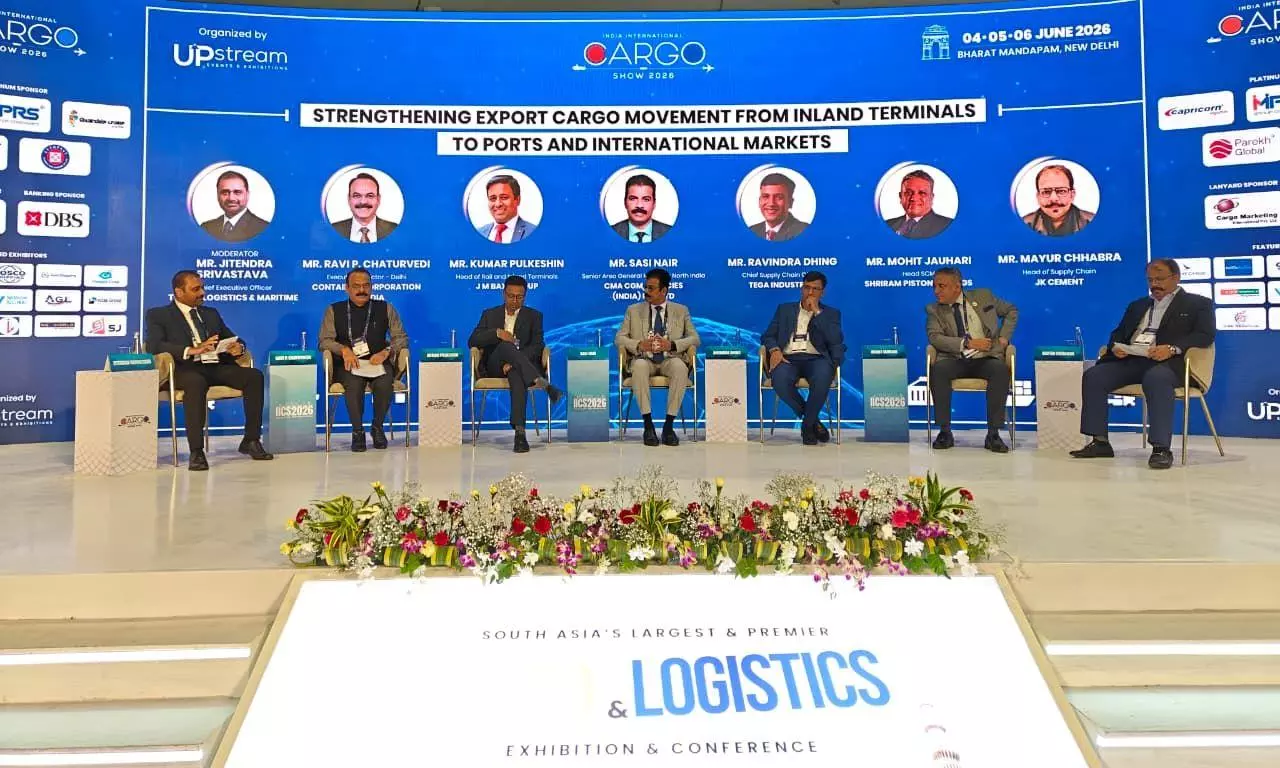


On a busy show floor at the India International Cargo Show 2026 in New Delhi, the conversation around India’s logistics story took a subtle but important turn. For years, the narrative has centred on building more terminals, expanding rail connectivity and investing in infrastructure. Now, the challenge is no longer just expansion, it is about making the system work consistently, efficiently and predictably.
Ravi P. Chaturvedi, Executive Director – Delhi at Container Corporation of India (CONCOR), set the tone by tracing the long arc of India’s trade journey. “The development of ICDs was a priority of the growing export-import trade of India,” he said, pointing to the country’s deep-rooted trading history. Today, that legacy is reflected in an expansive inland logistics network.
CONCOR alone operates “68 CONCOR-owned terminals and at 194 locations of railways, including container rail terminals and ECRPs, so the reach of terminals is really very high, and it is significant,” Chaturvedi noted. The scale is undeniable. Inland container depots, rail-linked terminals and logistics parks have proliferated across the country, especially in northern India.
However, scale, he suggested, is no longer the defining factor. “The smartness of the terminals and the smartness of the entire logistics chain lies in the visibility and the predictability,” he said. That shift from physical expansion to operational intelligence is now defining the next phase of India’s logistics evolution.
Chaturvedi described this transition as a move from “capacity building” to “resilience building”. In practical terms, that means integrating systems across the supply chain by linking first-mile transporters, rail operators, terminals and shipping lines into a cohesive, data-driven network. Technologies such as artificial intelligence and machine learning, he added, are beginning to play a role in forecasting flows, improving visibility and strengthening cost competitiveness.
If Chaturvedi outlined the ambition, Kumar Pulkeshin, Head of Rail and Inland Terminals at J M Baxi Group, highlighted the structural reality that the industry is trying to overcome. “For a long time, all the components of this whole supply chain have been working in a very fragmented manner. They have their own KPIs,” he said. Each stakeholder, including terminal operators, rail providers and logistics firms, optimised for its own performance indicators, often at the expense of end-to-end efficiency.
That fragmentation, however, is beginning to ease. “The objective of all of us is to deliver the cargo to the right person at the right time with the minimum cost,” Pulkeshin said. “The process of integration is also starting.”
He credited policy and infrastructure initiatives for nudging the ecosystem in that direction. The Dedicated Freight Corridor, long in the making, is now operational across key stretches, linking production centres to ports with greater speed and reliability. Complementing this is the PM Gati Shakti programme, which aims to align infrastructure planning across ministries and improve multimodal connectivity.
Operational interventions are also making a difference. Pulkeshin pointed to Indian Railways’ Niryat Express service as a step towards standardisation. “Earlier, when a container used to move from an inland container depot, we never knew when it would reach. Sometimes it would take 40 hours, sometimes 60 hours, and sometimes even a week,” he said. “But today it gives some predictability.”
Predictability, repeatedly invoked across the panel, is emerging as a critical factor in global trade competitiveness. It is also where India still faces gaps, according to Sasi Nair, Senior Area General Manager North India at CMA CGM. Speaking from the perspective of a global shipping line, Nair framed the issue through three lenses: “reliability, scalability and cost efficiency.” While acknowledging India’s progress, including what he described as “phenomenal growth in infrastructure development”, he cautioned that the current pace may not be sufficient to meet future demand.
“When you are talking about the growth pace that India is looking at, this may not be sufficient,” he said. “Consistency is also very important.” One of the less visible but deeply consequential challenges lies in cargo imbalances across regions and terminals. While India’s aggregate container volumes may appear balanced between imports and exports, the distribution is uneven.
“In North India, we have around 40 plus inland container depots having efficient connectivity with north-west gateway ports,” Nair said. “But when you go to specific inland container depots, there is a lot of mismatch in what comes, what goes and what type of equipment is required.”
This imbalance disrupts the economics of rail operations. Container train operators depend on steady two-way volumes to maintain cost efficiency. When imports outweigh exports or vice versa, equipment availability becomes a constraint, and reliability suffers.
“An efficient and cost-efficient model of rail can be achieved only when there is sufficient volume for both outbound and inbound movement,” Nair explained. The result is a continued reliance on road transport, even when rail offers environmental and operational advantages. “A lot of cargo goes by road because of geographical proximity and cost considerations,” he said, adding that there is a need to shift more cargo to rail to improve balance and efficiency.
Cost remains another critical concern. Despite improvements in transit time enabled by the Dedicated Freight Corridor, the expected cost advantages have not been fully realised. “When you are talking about the cost factor, it is still below expectation,” Nair said, noting that benefits are currently limited to specific routes and cargo segments.
Sustainability is also becoming central to logistics planning. Nair highlighted efforts by CMA CGM to deploy electric vessels, operate solar-powered warehouses and expand rail-based intermodal solutions as part of its decarbonisation strategy. “Everybody needs to focus on green intermodal sustainable solutions,” he said, aligning with India’s broader commitment to reducing carbon emissions.
The discussion ultimately underscored a common theme. India has made significant progress in building logistics infrastructure, supported by policy reforms such as the Goods and Services Tax, the National Logistics Policy and digitalised documentation systems. However, the next phase will depend on how effectively these assets are utilised.
The sector’s evolution now hinges on integration, coordination and data-driven decision-making. Visibility across the supply chain, synchronised operations among stakeholders and balanced cargo flows will determine whether India can deliver consistent performance.
As Chaturvedi emphasised, the future of India’s logistics ecosystem will be defined not just by capacity, but by “predictability, visibility and cost competitiveness” as the country seeks to strengthen its position in global trade.