
Why India’s logistics gap with China still runs deep
As India scales manufacturing and exports, logistics gaps in infrastructure, speed and cost, especially versus China, remain a drag on competitiveness.
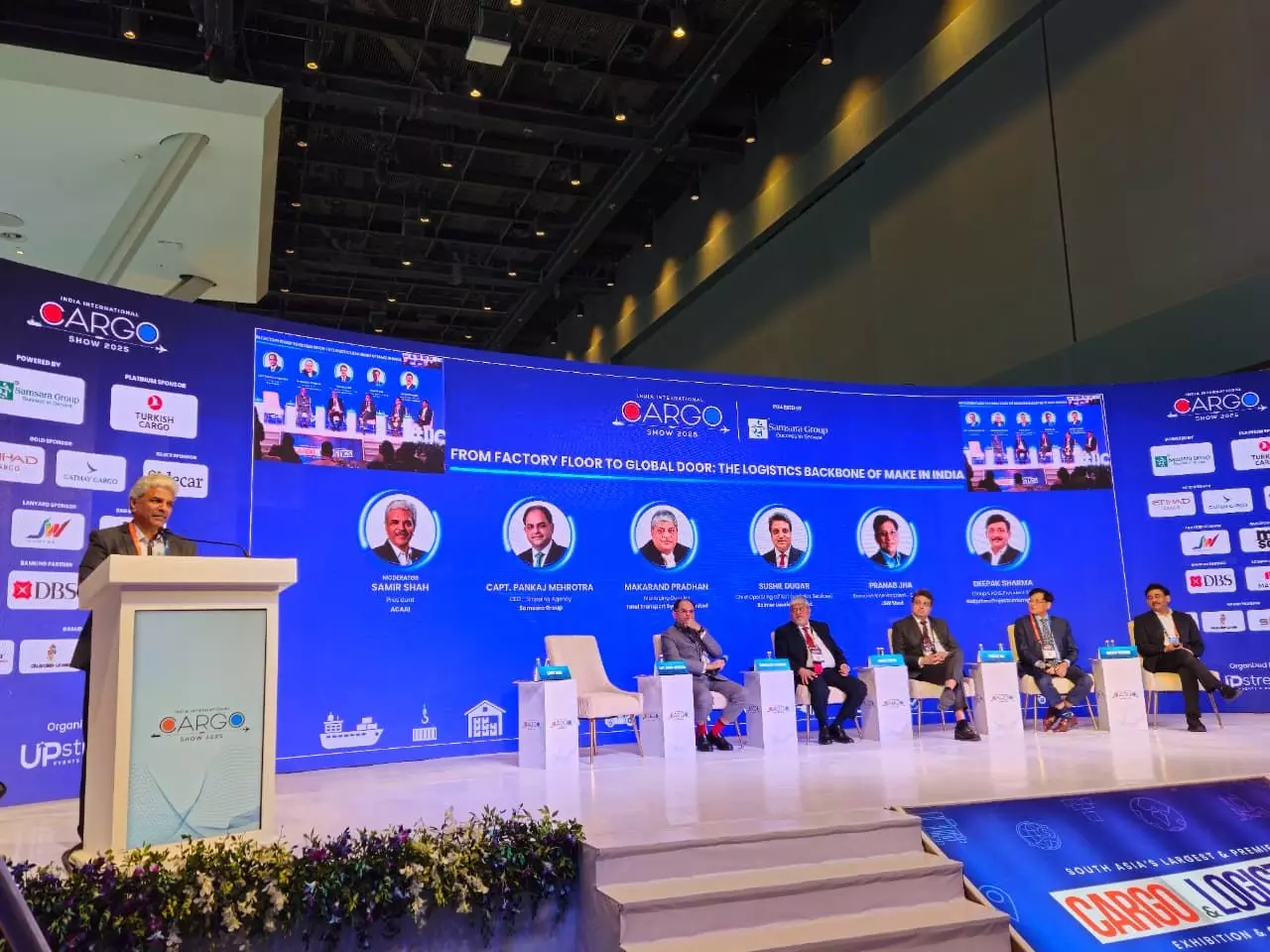
Samir J Shah of ACAAI, Pankaj Mehrotra of Samsara Group, Makarand Pradhan, Total Transport Systems, Sushil Dugar of Balmer Lawrie & Co, Pranab Jha of JSW Steel and Deepak Sharma of Kalpataru Projects International during IICS 2025.


As India pushes to position itself as a global manufacturing and export hub, logistics leaders are warning that deep structural gaps, especially when compared with China, continue to undermine competitiveness. From ports and first-mile connectivity to aviation, shipping control and transhipment dependence, industry voices say execution speed and scale remain India’s biggest constraints.
India’s ports and roads lag global benchmarks
Venkateswara Rao, Head of Logistics, APAR Industries, contrasted India and China sharply on infrastructure readiness and execution speed. Having travelled to China many times, he finds the difference obvious on the ground.
“It’s not as easy as in Europe, the US or in China,” he said, noting that India’s economy is growing faster than its infrastructure: “India is growing at six to eight percent and infrastructure is not growing at that pace.”
He was speaking in Mumbai at the recently concluded India International Cargo Show (IICS 2025).
Rao described daily pain points for shippers: truck shortages in many regions and rail services that are too slow to meet customer expectations.
“Moving by rail 1,500 kilometres takes seven to eight days. Every customer wants their cargo yesterday.” He blamed structural regional imbalance; western India receives more focus, while eastern India, despite its mineral wealth, lacks roads, rail, and port evacuation capacity.
Benchmarking ports magnifies the gap.
“Ports like Antwerp, Rotterdam, and Shanghai are far ahead,” Rao said. Ambitious new projects such as Vadhvan will take years to reach scale. His prescription: build multiple mega ports, not isolated ones, “we need four Vadhvan ports, north, east, west, south”, and create seamless port access with green channels and dedicated roads. Until then, companies are forced to create their own ports and logistics solutions to remain competitive.
Rao warned that high logistics costs must fall to make Indian manufacturing globally competitive. While he focused on physical infrastructure, others pointed to structural risks within India’s logistics ecosystem.
Learning from China: regional airlines and shipping lines
Mukesh Oza, Group President & CEO, Samsara Group, argued that India’s aviation and logistics system is fragile because it depends on a few national carriers. Recent disruptions showed how concentrated systems can fail passengers and cargo alike.
Oza pointed to China’s decentralised model, many regionally anchored carriers and shipping lines that ensure reliable connectivity, and urged India to adapt that approach.
He proposed state-anchored regional airlines and shipping lines tied to manufacturing clusters (e.g., Mumbai/Ahmedabad supporting Maharashtra and Gujarat). Oza also highlighted nascent domestic capabilities, an ISO container manufacturing hub in Bhavnagar and an Airbus assembly facility in Vadodara, plus aircraft and rolling-stock manufacturing in public-sector units, as foundations for a stronger, less import-dependent logistics ecosystem.
His message is to empower regions, build local carriers and maritime lines, and integrate them with domestic manufacturing to boost resilience and exports. If aviation resilience is one concern, exporters say the real competitiveness battle is being fought on logistics costs.
Logistics costs erode India’s pricing advantage
Deepak Sharma, Group CPO & President SCM, Kalpataru Projects International, called logistics the single biggest differentiator for exporters and said China remains the unavoidable benchmark. Even when manufacturing costs match, higher logistics costs erode competitiveness: “So we either get less margin or we have to increase prices.”
Sharma identified three structural problems: weak first-mile connectivity from factories to ports, excessive customs inspections, and heavy dependence on transhipment hubs. Manufacturing clusters in India are dispersed and often poorly connected to ports; rail and waterways usage remain low. In his Raipur example, infrequent rail services force costly road shipments.
Despite digitisation, he said customs inspections still affect about 25% of shipments, causing delays and uncertainty. And reliance on transhipment creates unpredictable transit times, sometimes adding weeks, harming cash flow and profitability. He acknowledged government steps, dedicated freight corridors and policy reforms, but warned real competitiveness needs these three issues fixed at scale. The scale of India’s challenge becomes even clearer when viewed through a macro and port-capacity lens.
China’s scale dwarfs India’s throughput
Pankaj Mehrotra, CEO – Shipping Agency, Samsara Group, quantified the scale gap: “China handles 300 million TEUs; India struggles with 25 million TEUs.” Shanghai alone handles about 50 million TEUs, double India’s total, illustrating not just volume but the maturity of port-hinterland integration.
Mehrotra linked infrastructure shortfalls to macro pressures: rising imports, trade deficits, currency pressures and higher procurement and logistics costs. He stressed speed of execution: India must accelerate infrastructure build-out or risk losing competitiveness, “we cannot be moving at an analogue speed in a digital world.” Others noted that the competitive pressure is intensifying, not just from China but from emerging manufacturing hubs.
Multiple agencies, hidden costs slow Indian logistics
Sushil Dugar, COO (Logistics Services), Balmer Lawrie & Co, warned India faces competition not only from China but from fast-improving Vietnam.
He emphasised logistics cost and fragmentation: multiple agencies across clearance, movement and delivery add hidden costs. Trucking productivity and multimodal linkages remain weaker than global peers. Dugar highlighted that dedicated freight corridors can be transformational, raising rail speeds from ~25 km/h to ~75 km/h, reducing transit time and costs substantially.
His message: India must align clusters, ports and corridors to minimise transit time and lower logistics costs, or risk losing ground. From an exporter’s standpoint, logistics control is becoming as important as production efficiency.
Lack of domestic shipping lines limits competitiveness
Pranab Jha, EVP – Shipping, JSW Steel, called the China comparison a spur to urgency. He observed that early logistics gains in India are exhausted, and further progress requires systemic changes across stakeholders.
A major disadvantage is the lack of domestic control over shipping and containers: India has no large national container carrier, while China developed COSCO to secure freight economics. This lack of scale and dedicated shipping options makes opening new trade lanes, such as South America, difficult and expensive.
Jha also noted process issues: digitisation initiatives face institutional resistance from banks and authorities, slowing progress. He argued India needs faster port capacity expansion, more and larger hub ports, to move cargo in time and at competitive cost. At the operational end of the supply chain, consolidators say these structural gaps are felt most acutely.
CFS capacity and congestion constrain growth
Makarand Pradhan, MD, Total Transport Systems, spoke from a consolidator’s perspective about operational limits. Consolidators depend on container freight station (CFS) operators and carriers; congestion, transhipment issues and limited CFS capacity constrain growth.
While turnaround times and documentation have dramatically improved, from 12 days to one, CFS capacity is now a bottleneck: “If tomorrow one or two consolidators have to come up, they don’t even have the possibility of getting the shed space.”
Pradhan said India has improved but still lacks the scale, redundancy and resilience Chinese consolidators enjoy. Private players are improvising to absorb newcomers, but systemic expansion is needed.
India’s logistics ecosystem must move from incremental improvement to structural transformation if it wants to compete head-on with China in global trade.