
Manufacturing surge reshapes India’s export logistics play
India's ambitious manufacturing push aims for a 25% GDP share by 2035. It is gaining momentum and transforming the nation's export logistics landscape.
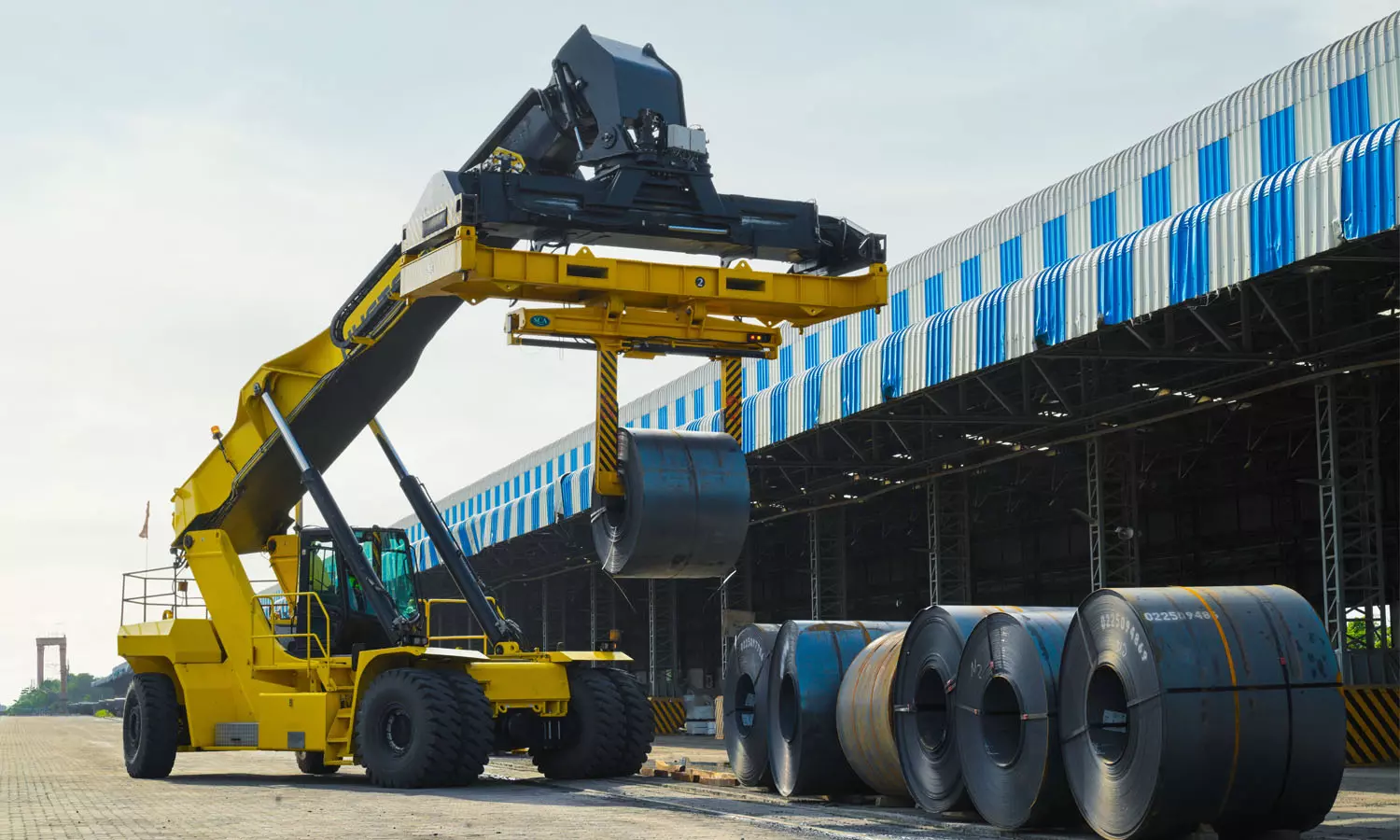


As export volumes continue to rise, the focus has shifted beyond production to the efficiency of moving goods to global markets with speed, reliability, and cost effectiveness. Behind every container bound for Europe or every high-value shipment headed to the United States is a logistics backbone under pressure and undergoing rapid transformation.
This shift is supported by strong manufacturing momentum. According to the Press Information Bureau (PIB), the sector recorded Gross Value Added (GVA) growth of 7.72 per cent in Q1 and 9.13 per cent in Q2 of FY 2025-26. Medium- and high-technology industries now contribute 46.3% of manufacturing value added, reflecting a move toward more complex and higher-value production. Export performance has also strengthened, reaching $634.3 billion during April–December 2025, marking a 4.3 per cent year-on-year increase.
Digitalisation is playing a critical role in improving transparency, predictability, and efficiency across India’s export logistics ecosystem.
Anish Kumar Jha, Kuehne+Nagel
Manufacturing expansion reshaping export cargo flows
Manufacturing’s contribution to India’s GDP has risen in recent years. As per PIB and Economic Survey data, growth has been most visible in electronics, engineering goods, automobiles and components, and agro-processed and pharmaceutical exports. These sectors depend on strict lead-time adherence and frequent global shipments. As industrial clusters expand across Gujarat, Tamil Nadu, Telangana, and the Delhi-NCR region, the nature of export cargo is evolving. There is a clear shift towards high-value and high-frequency shipments, with reduced reliance on bulk commodities.
As Anish Kumar Jha, Managing Director – India, Sri Lanka, and Maldives, Kuehne + Nagel, explains, “India’s manufacturing growth is reshaping export cargo flows in a more distributed and adaptive way. As production expands across sectors such as electronics, automotive, chemicals and pharmaceuticals, export activity is spreading beyond traditional port-centric hubs to align more closely with inland manufacturing clusters.”
This transition demands logistics systems that are faster, more predictable, and aligned with just-in-time manufacturing models. Jha adds, “At the same time, the rise in higher-value and time-sensitive exports is driving more deliberate shipment planning, with increased use of combined transport modes, optimised lead times and data-led routing decisions.”
The geography of export flows is also changing. Trade is no longer concentrated in a handful of major gateways. Manufacturers in Tier 2 and Tier 3 cities now require access to advanced logistics services across air, sea, and land. Supply chains have become more complex, with semi-finished goods moving between facilities across states before final assembly and export.
Adhendru Jain, CEO – Rail and Inland Terminals, DP World SCO, notes, “Export cargo flows are shifting from bulk commodities to higher-value, time-sensitive shipments, requiring agile freight solutions. Supply chains are increasingly cluster-based, with hubs in Gujarat, Maharashtra, Tamil Nadu, and Delhi NCR, Uttar Pradesh, demanding direct multimodal connectivity to ports.”
Efficient inland logistics plays a very critical role in enabling export performance
Kartik Daftari, Hi-Tech Radiators
Export gateways under pressure as capacity scales
India’s export gateways, both maritime and air, are coming under increasing strain as trade volumes rise in line with the country’s expanding manufacturing base and deeper integration into global supply chains. Major ports are undertaking capacity expansion through the addition of new berths, dredging to allow deeper drafts for larger vessels, and the modernisation of container yards with automation and digital systems. These measures are intended to reduce vessel turnaround times and improve overall cargo handling efficiency in line with international standards.
Airport cargo infrastructure is also being upgraded across key hubs, including Delhi, Mumbai, Bengaluru, Chennai and Hyderabad. Investments are being directed towards temperature-controlled cold chain facilities to support pharmaceuticals and perishable goods, dedicated express cargo terminals to handle e-commerce shipments, and expanded bonded warehousing to facilitate smoother customs clearance. Increased use of automation and digital tracking is helping operators manage higher cargo volumes with greater accuracy and speed.
However, capacity development remains uneven across the network. While major ports and primary air cargo hubs have seen measurable improvements in infrastructure and operational efficiency, emerging ports and secondary airports continue to face constraints. Connectivity gaps, particularly in hinterland links, remain a concern and can lead to congestion during peak periods. Limited integration with rail and road networks further affects the efficient movement of goods to and from gateway points, which can hinder the overall logistics performance and delay the timely delivery of exports.
These developments reflect the scale of India’s export ambitions. With manufacturing exports projected to approach one trillion dollars by 2030, the focus is shifting towards the creation of more integrated and efficient gateway ecosystems. Sustained progress will depend on coordinated investment not only at ports and airports but also across inland logistics networks to support reliable and timely cargo flows.
Exporters are increasingly operating within supply chains that span multiple geographies, regulatory regimes and supplier ecosystems.
Smitha Shetty, Achilles Information Ltd.
Inland logistics and multimodal connectivity
The efficiency of export logistics depends as much on inland connectivity as on port and airport capacity. Strengthening the first mile and last mile between factories and gateways has become a priority.
Kartik Daftari, MD & CEO at Hi-Tech Radiators, highlights the operational reality for heavy engineering exporters: “Efficient inland logistics plays a very critical role in enabling export performance, particularly in a country like India where exports are becoming increasingly important to overall economic growth. For companies which are in the heavy engineering space, the complexity is higher given the movement of large, high-value equipment that requires careful planning and specialised handling.”
He adds, “For heavy and oversized equipment, consistency in infrastructure design such as road levels, bridge clearances, and utility placements can make a significant difference in ensuring seamless movement.”
Private sector logistics networks are also expanding to bridge these gaps. Ketan Kulkarni, Managing Director & Chief Executive Officer, Allcargo Logistics, says, “As India’s manufacturing footprint expands across emerging industrial clusters, the role of integrated logistics networks in connecting production hubs with export gateways is becoming increasingly important. Manufacturers look for faster and more predictable cargo movement from inland clusters to ports, airports and ICDs.”
He adds, “Our Allcargo Extended Reach (AER) network, which covers 100% of India’s GDP, is helping connect even remote and emerging manufacturing locations into the broader logistics grid, ensuring more seamless first- and last-mile linkages.”
The push towards integrated infrastructure is also evident in rail-led solutions. Jain notes, “We offer a comprehensive portfolio of scheduled rail freight with integrated first- and last-mile trucking, time-bound scheduled rail services, and real-time cargo visibility, ensuring seamless port-to-hinterland connectivity.”
Integrated logistics networks are becoming increasingly important in connecting production hubs with export gateways.
Ketan Kulkarni, Allcargo Logistics
Logistics efficiency and digitalisation as competitive drivers
Export competitiveness is increasingly tied to logistics performance. For manufacturers, logistics costs and reliability directly affect margins and global positioning.
Daftari underscores this pressure: “The logistics cost accounts for about 20% of our revenue. As we compete in global markets, improving cost efficiency remains an important lever in strengthening our overall competitiveness.”
He adds, “The need of the hour is for logistics to evolve much faster – in terms of cost efficiency, reliability and digital integration – to support India’s global manufacturing ambitions.”
Digitalisation is emerging as a key enabler across the ecosystem. Kulkarni explains, “Digitalisation is playing a pivotal role in strengthening export supply chains by improving visibility, predictability and operational efficiency. At Allcargo Logistics, we leverage advanced digital platforms, AI-driven analytics and IoT-enabled tracking systems to provide real-time visibility across our network.”
From an ecosystem perspective, digital verification is also becoming critical. Smitha Shetty, Regional Director, APAC – Achilles Information, says, “Digital platforms allow companies to move beyond manual supplier checks and fragmented data sources. They provide a structured way to collect, validate and analyse supplier information across areas such as financial stability, ESG performance, health and safety practises and regulatory compliance.”
She adds, “For Indian exporters serving global markets, this level of visibility is becoming essential. International buyers expect reliable, verifiable information about who their suppliers are and how they operate.”
Jain points to platform integration as the next step, stating, “Digitalisation and visibility tools are essential in export logistics, ensuring real-time transparency, predictive planning, and resilience.”
The increase in manufacturing and exports in India has been driven by PLI schemes, GST rationalisation and infrastructure upgrades.
Adhendru Jain, DP World
The road ahead focused on integration
India's logistics transformation is moving beyond capacity expansion towards system-wide integration. While new infrastructure will continue to be developed, the emphasis is shifting to how effectively it is connected within a national network.
As Shetty notes, supplier compliance and transparency are central to global buyers, strengthening trust, reducing uncertainty, enabling smoother market access, and supporting stronger participation in global value chains.
Policy direction and private investment are aligning around seamless connectivity and data-driven operations. As manufacturing output rises through the decade, the success of India’s export strategy will depend on how efficiently goods move from production lines to international markets.
The evolution of manufacturing and logistics is closely linked. A robust logistics ecosystem is essential to sustain industrial growth, while rising manufacturing output provides the scale needed to justify infrastructure investment. Together, they will determine the global reach and competitiveness of the Made in India proposition in the years ahead.