
Inside TVS ILP’s 4 lakh sq ft Grade-A warehousing park in Madurai
TVS ILP’s fully leased Madurai facility is seeing demand from FMCG, FMCD, 3PL, manufacturing and automotive sectors, reflecting growing demand for organised warehousing in Tier-II and Tier-III markets.
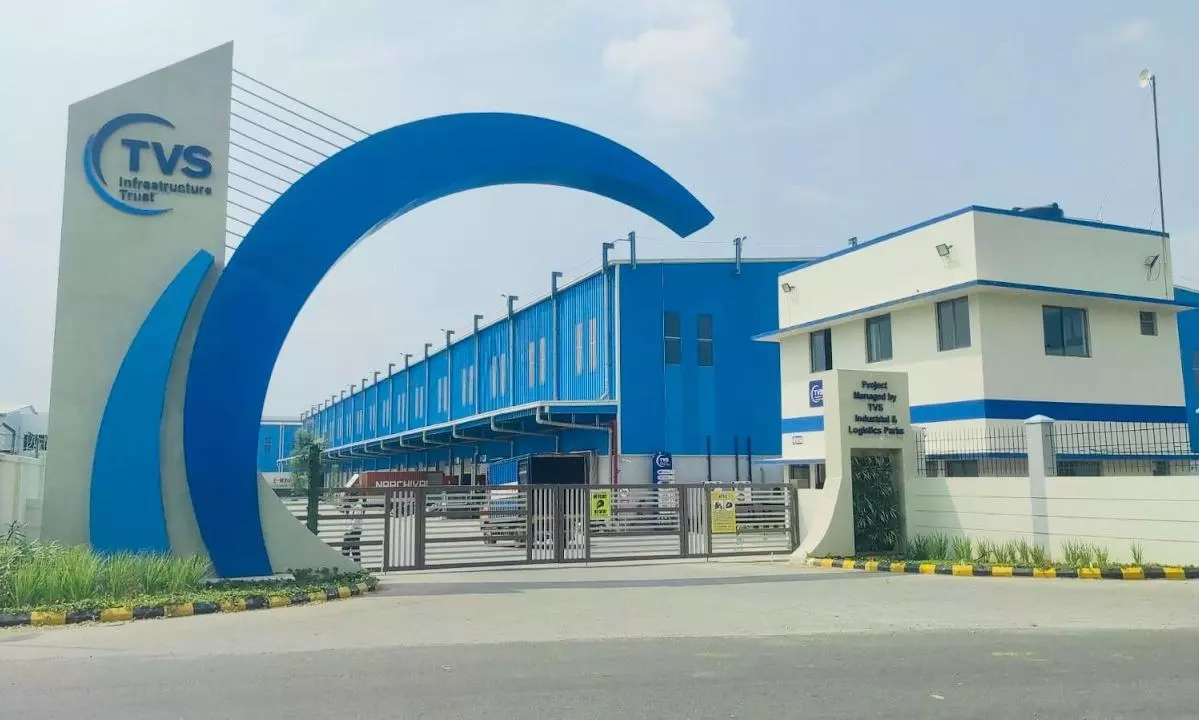


A fully occupied warehouse park in Madurai, Tamil Nadu is highlighting the growing demand for organised logistics infrastructure beyond India’s major metros. Spread across 16 acres, the TVS Industrial & Logistics Parks (TVS ILP) facility offers approximately 4 lakh sq ft of Grade-A warehouse space across two buildings and serves seven customers from the FMCG, FMCD, third-party logistics (3PL), auto-ancillary and automobile sectors.
The Grade-A park, which holds preliminary EDGE certification, supports a diverse mix of consumer durables, fast-moving consumer goods (FMCG), cold-chain and manufacturing-linked operation.
To ensure high-velocity forklift operations and heavy industrial handling, the facility is engineered with laser-screed, FM2-compliant flooring capable of supporting a 5 tons per square meter load capacity. Built with long-term sustainability and operational continuity in mind, the park features modern water treatment systems, integrated rainwater harvesting structures, and advanced NBC-standard firefighting infrastructure.
Backed by round-the-clock 24/7 technical and security support, the setup guarantees robust safety, maximum resource efficiency, and uninterrupted supply chain management for its tenants.
According to Ms. Aditi Kumar, Joint Managing Director, TVS ILP, “Demand in Madurai is coming from a diverse mix of sectors rather than being concentrated around one category. FMCG, FMCD, 3PL, manufacturing and automotive businesses are all contributing to the growing demand for organised industrial and logistics infrastructure in the region.”
She added that businesses increasingly require Grade-A infrastructure that offers flexibility, scalability and connectivity to support evolving operational and distribution needs. Manufacturing and automotive occupiers have more specialised requirements linked to production and supply networks, while FMCG and FMCD companies require efficient warehousing and distribution capabilities.
TVS ILP’s Madurai facility benefits from connectivity via National Highways 7, 45B, and 85, linking key cities like Chennai and Coimbatore. Its location also provides access to industrial centres such as Dindigul and Virudhunagar, strengthening Madurai’s role as a regional distribution hub. Proximity to Madurai Airport and road connectivity towards the Thoothukudi port region further support the facility’s logistics potential.
The surrounding industrial ecosystem, spanning automotive components, rubber, textiles, chemicals and food processing, creates demand for warehousing that serves manufacturing supply chains and regional distribution networks.
Seven clients and a diverse occupier base
The Madurai facility currently houses seven clients across FMCG, FMCD, third-party logistics, auto-ancillary and automobile sectors. Its marquee occupiers include Whirlpool, Blue Star, Haier, Butterfly, Crompton Greaves and Dairy Day, alongside space allocated to group company TVS Srichakra, with TVS Supply Chain Solutions (TVS SCS) as its 3PL.
The facility is currently at 100% occupancy, with rental rates of approximately ₹18–₹22 per square foot per month, according to Kumar.
Cold-chain, consumer durables and automotive operations
Blue Star’s operations at the park highlight its daily warehouse activity. More than 20 trucks move in and out of its dedicated warehouse each day. Inventory is tracked in real time through a warehouse management system (WMS), while a transport management system (TMS) coordinates inbound and outbound truck movements.
The park also accommodates Dairy Day’s cold-storage operations, with dedicated cold rooms maintained at temperatures as low as -22°C for products such as ice cream. The temperature-controlled infrastructure supports the storage requirements of products that require specific conditions throughout the supply chain.
Manufacturing-linked operations form another component of the facility’s activity. Approximately 85,000 square feet of warehouse space is dedicated to tyre-handling operations for TVS Srichakra, with TVS SCS managing the handling process. The operation handles around 55,000 tyres daily across inbound and outbound movements, including quality checks, vertical stacking to maximise storage capacity and the use of foldable containers to move stock towards outbound trucks once orders are ready.
The containers can then be removed from the stack, freeing up space for subsequent operations.
These activities underline the range of infrastructure and operational processes required to serve tenants with different inventory profiles, product characteristics and distribution cycles.
FMCG and FMCD lead growth
Across its wider portfolio, TVS ILP identifies FMCG and FMCD as its fastest-growing sectors, followed by third-party logistics. Kumar said the demand from these sectors has increased the need for warehousing that combines flexibility, scalability and efficient distribution capabilities.
However, she does not see the market moving towards one dominant facility format, such as cold-chain or built-to-suit industrial space.
“The nature of the business, its operating model and the scale of its requirements determine the kind of facility it needs,” she said.
Built-to-suit facilities remain important for customers with specific operating requirements, with TVS ILP working closely with occupiers to develop infrastructure suited to their businesses while maintaining operational efficiency and environmental alignment.
The company is also seeing growing demand across Tier-II and Tier-III markets as e-commerce expands and consumption patterns evolve. Kumar said more than 60% of e-commerce transactions come from these markets, creating a need for flexible and scalable warehousing closer to emerging consumption centres.
She cited the expansion of FMCG and e-commerce businesses, including Nestlé and Flipkart, across smaller markets as an indicator of this trend. Quick commerce is contributing to the shift, with a warehouse requirement in Coimbatore involving Transport Corporation of India (TCI) to support Zepto’s quick-commerce operations, reflecting the growing need for strategically located facilities as the segment expands beyond major metropolitan areas.
For TVS ILP, this reinforces the importance of maintaining a distributed network of well-connected facilities that can support regional inventory positioning and fulfilment requirements.
ONE TVS ILP brings operations onto a digital platform
Technology is another part of the company’s effort to improve the customer experience. In July 2026, TVS ILP launched ONE TVS ILP, an AI-driven operations and business development application designed to bring information and customer interactions onto a single platform.
The application features a voice-first interface through which clients can access information using voice or text. Its ‘Ask-Me’ virtual assistant helps users retrieve information, while the platform provides real-time site information, warehouse space availability, lease metrics and commercial rental benchmarks.
Clients can also raise facility service and maintenance requests through the application. These requests are routed to the relevant support teams, with alerts and round-the-clock assistance intended to improve coordination and make issue resolution more responsive.
According to Kumar, the application is helping streamline operations and business development by consolidating touchpoints that were previously handled separately.
“The larger objective is to provide tech-enabled logistics infrastructure solutions to our clients, making everyday interactions faster, more transparent and easier to manage,” she said.
Expansion across India
Established in 2005 as a partnership between TVS Supply Chain Solutions and the Ravi Swaminathan family, TVS ILP describes itself as India’s first corporate developer focused on Grade-A warehousing. Its first warehouse was established in Chakan, Pune, in 2006.
Between 2011 and 2015, the company expanded across major Indian cities, growing its footprint to approximately 1 million square feet. From 2016 to 2020, TVS ILP expanded its Grade-A warehousing network across India and became the first Grade-A warehouse developer in the eastern region with a facility in Odisha. Between 2021 and 2026, the company attracted significant investments from British International Investment (BII) and Lingotto Opportunity Fund, received EDGE Champion recognition from the International Finance Corporation (IFC), a member of the World Bank Group, and listed its warehousing assets on the National Stock Exchange (NSE) through TVS Infrastructure Trust, an Infrastructure Investment Trust (InvIT).
TVS ILP currently operates 18 underlying assets across 14 locations, with a scaled portfolio of approximately 12 million square feet. Its operational footprint includes Chakan, Vaipoor, Singadivakkam, Hosur, Bhubaneswar, Redhills, Madurai, Coimbatore, Sullurpet, Siliguri, Pillaipakkam, Vijayawada, Visakhapatnam, and Kochi. Ongoing developments in hubs like Cuttack and Indore are actively progressing.
The company’s development platform spans 20 million square feet, of which 10.7 million square feet has already been transferred to the InvIT. The balance is expected to be developed and transferred over the next two to three years. TVS ILP is currently working on projects totalling 5–7 million square feet as part of this pipeline.
Its longer-term ambition is to reach 20 million square feet across 30 cities, with a network designed to provide a facility approximately every 400 kilometres across India. The next three years are expected to focus on doubling capacity, with greater emphasis on North and Central India alongside continued expansion in the South and Northeast.
Investments in Tamil Nadu and other markets
TVS ILP has committed ₹1,000 crore to expand its Tamil Nadu portfolio under a pact signed with the state government on 13 August 2026, at the VETTRI Tamil Nadu Investment Conclave 2026. The investment is expected to create approximately 1,500 jobs and expand the company’s existing portfolio of 10 parks in the state.
In Madhya Pradesh, the company is completing work on a ₹250 crore, 20-acre built-to-suit park in Pithampur, marking its first entry into Indore. In West Bengal, it has signed a memorandum of understanding for a 10-acre logistics park in Siliguri, its second major investment in the state. These initiatives follow earlier MoUs with the governments of Telangana and Karnataka, each valued at approximately ₹200 crore.
The expansion strategy reflects the company’s effort to extend its network into emerging industrial and consumption markets, where demand for organised warehousing is growing.
Driving growth through sustainable infrastructure
Sustainability remains an important part of TVS ILP’s infrastructure strategy. Across its portfolio, the company reports annual water savings of 2,000 million litres and energy savings of around 16 million units, alongside nearly 12,000 tonnes of annual carbon savings and over 17,500+ trees planted.
Approximately 30% of its clients come from sustainability-focused sectors, according to the company.
TVS ILP is part of TVS Mobility Group, which traces its origins to 1911, when T. V. Sundaram Iyengar established the business in Madurai. The group now comprises more than 50 companies worldwide, employs over 50,000 people and reports annual revenue of approximately US$9 billion.
With Madurai operating at full occupancy and demand coming from a broad mix of industries, the facility reflects TVS ILP’s strategy of developing location-specific infrastructure for both consumption-led and manufacturing-linked supply chains. The company’s expansion across emerging markets, combined with technology-enabled operations and sustainability measures, is intended to support its next phase of growth in India’s organised warehousing sector.