
India to build first riverine lighthouses on Brahmaputra waterway
Four solar-powered navigation towers planned on NW-2 to improve safety and support rising cargo traffic.
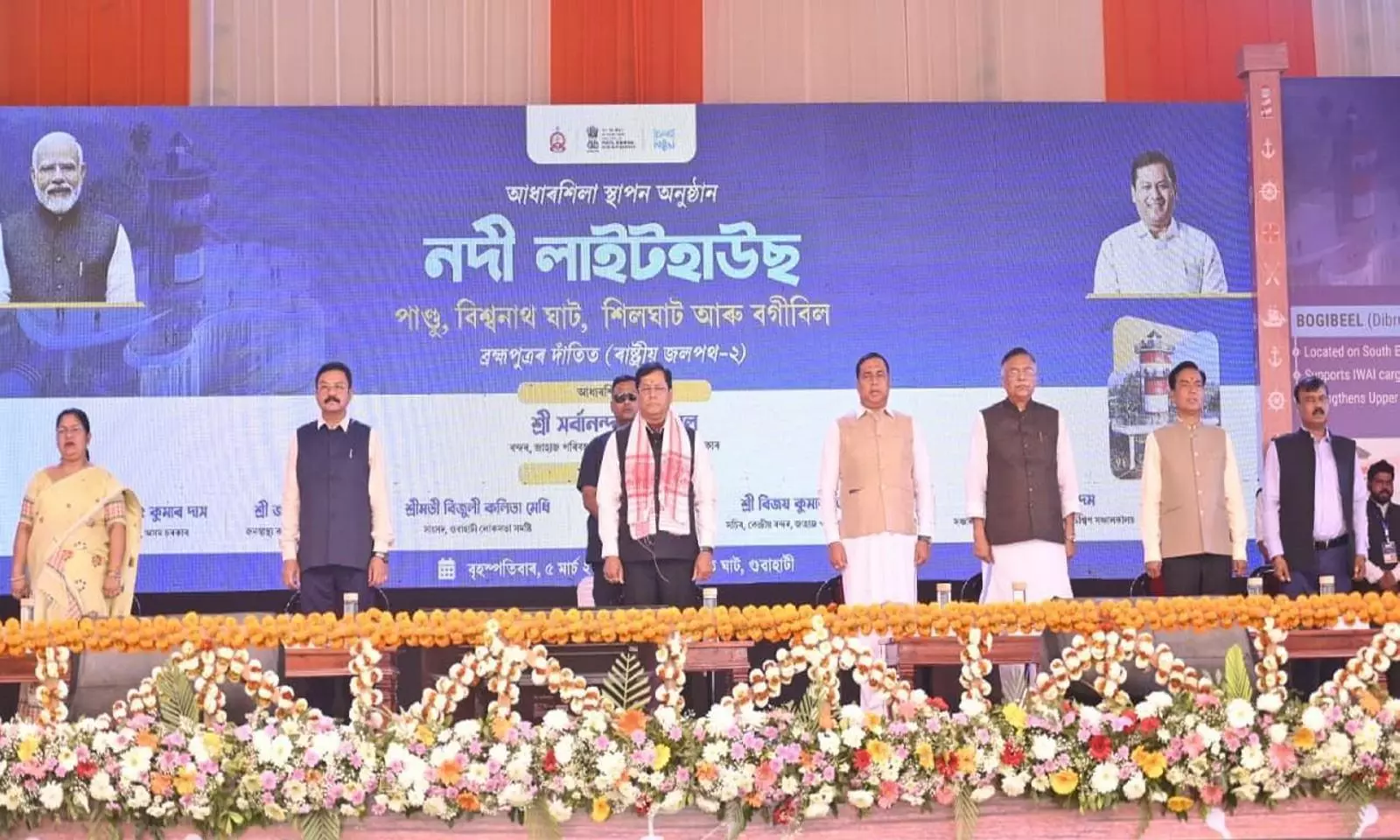


India will establish its first riverine lighthouses along the Brahmaputra River after Union Minister of Ports, Shipping and Waterways Sarbananda Sonowal laid the foundation stones for four facilities on the inland waterway. The project marks the first time lighthouse infrastructure will be developed on an inland waterway in the country.
The foundation stone ceremony took place at Lachit Ghat and was jointly organised by the Directorate General of Lighthouses and Lightships (DGLL) and the Inland Waterways Authority of India (IWAI) under the Ministry of Ports, Shipping and Waterways.
The four lighthouses will be located at Bogibeel in Dibrugarh district, Pandu in Kamrup (Metro) district, Silghat in Nagaon district and Biswanath Ghat in Biswanath district. Three of the sites, Bogibeel, Pandu and Silghat are located along the south bank of the river, while Biswanath Ghat is situated on the north bank.
The facilities will be developed along the Brahmaputra (National Waterway-2), one of India’s key inland cargo and passenger corridors. The combined investment for the four projects is estimated at about ₹84 crore.
Each lighthouse will be 20 metres tall and will have a geographical range of 14 nautical miles and a luminous range of 8–10 nautical miles. The structures will be powered entirely by solar energy. In addition to navigational infrastructure, each site will include a museum, amphitheatre, cafeteria, children’s play area, souvenir shop and landscaped public spaces, with the aim of developing the locations as tourist attractions alongside their navigational role.
The riverine lighthouses are being developed following a 53 percent increase in cargo movement on the Brahmaputra waterway during the financial year 2024–25, according to IWAI. Cargo traffic on National Waterway-2 has been rising steadily and the corridor plays an important role in supply chains serving Assam’s tea, coal and fertiliser industries, in addition to supporting passenger and tourism movement.
The new facilities are expected to support round-the-clock navigation on the waterway. They will also include weather observation sensors and other navigational infrastructure required to support the continued growth of freight and passenger traffic on the river.
“Under the dynamic leadership of Prime Minister Shri Narendra Modi ji, inland waterways are not merely an alternative to roadways and railways but they are being energised and enabled as force multiplier for our economy. A tonne of freight moved by water costs a fraction of what road transport demands, generates a fraction of the carbon, and frees our highways for passengers and time-sensitive goods. These lighthouses on the Brahmaputra are a statement of intent: that India’s rivers are open for business, round the clock,” Sonowal said.
The foundation ceremony was attended by Ranjeet Kumar Dass, Minister of Tourism, Government of Assam; Charan Boro, Minister of Transport, Government of Assam; Jayanta Mallabaruah, Minister of Public Health Engineering, Government of Assam; Bijuli Kalita Medhi, Member of Parliament from Guwahati; and Siddhartha Bhattacharya, MLA from East Guwahati. Senior officials present included Vijay Kumar, Secretary, Ministry of Ports, Shipping and Waterways, and N. Muruganandam, Director General, DGLL.
“Waterways offer a decisive cost advantage. Moving a tonne of cargo by inland waterway costs roughly one-third of road transport and half of rail. For a region like Northeast India, where road infrastructure is perpetually under pressure from both traffic and terrain, activating the Brahmaputra as a full-scale freight corridor is not a choice but a necessity,” Sonowal added.
The project was initiated after the Minister’s Office explored the feasibility of developing river lighthouses in the Northeast. A Memorandum of Understanding between IWAI and DGLL covering the four sites was signed on April 8, 2025. The sites were transferred to DGLL under Right of Use agreements in June 2025 after a technical proposal was placed before the Central Advisory Committee for Aids to Navigation.
Each lighthouse is expected to be completed within 24 months after the award of the contract, following geotechnical investigations, topographic surveys and detailed design work.
“As traffic on NW-2 grows, the environmental and congestion benefits compound, fewer emissions, less road wear, lower accident risk, and a more resilient supply chain for the Northeast. The Deepstambh lighthouses will make night navigation safe and reliable, removing the single largest barrier to round-the-clock waterway operations,” Sonowal said.
The Directorate General of Lighthouses and Lightships is responsible for providing aids to navigation across India’s 11,098-kilometre coastline and is now expanding its role to inland waterways. The Inland Waterways Authority of India manages the country’s network of national waterways spanning more than 20,000 kilometres.
National Waterway-2 connects Dhubri to Sadiya in Assam across a navigable stretch of 891 kilometres, making it the longest navigable stretch of any Indian waterway and a key route through the Northeast. The four river lighthouses mark the beginning of a wider programme to equip inland waterways with navigational safety infrastructure similar to that used along India’s coastline.