
How India’s logistics networks are being rebuilt for 2026 and beyond
The next phase of network design is not about handling occasional surges but about operating continuously without slack.


India’s logistics system has rarely had the option of slowing down. What has changed in recent years is not only the volume moving across highways, warehouses, ports and industrial corridors, but also the intensity at which the system is now expected to operate every day. The familiar rhythm of festive peaks followed by quieter recovery periods is fading. In its place is a permanently high-pressure network that must deliver consistency, speed and cost control at scale.
As India moves through 2025 and into 2026, logistics is being rebuilt not as a series of tactical responses to demand spikes, but as a structural backbone designed to operate at elevated baselines by default. The question facing operators is no longer how to absorb short-term surges, but how to sustain performance when there is no meaningful downtime between cycles.
This shift is visible across freight categories. Manufacturing-led freight, e-commerce flows, containerised exports and regional distribution are all expanding simultaneously, compressing recovery windows between cycles. Investments in highways, dedicated freight corridors and industrial parks have improved physical connectivity, but the deeper transformation is operational.
“MOVIN is adapting its network and operating model to meet the rising demand for higher shipment velocity and tighter delivery windows by building a tech-enabled, performance-driven logistics ecosystem, allowing us to orchestrate movements with accuracy and transparency across India’s commercial corridors,” noted Gregory Goba-Blé, Head of UPS India and Director of MOVIN Express.
Networks are being redesigned around predictability and utilisation rather than volume alone. The emphasis is moving from how much capacity exists on paper to how effectively it can be deployed, measured and sustained under continuous load. Reliability, not surplus, is becoming the organising principle.
Fleet strategy moves from peak coverage to consistency
For fleet operators, particularly in heavy-duty and linehaul logistics, this environment has forced a fundamental rethink of deployment strategy. Rahul Kanuganti, Managing Director and CEO of Flytta Green, says capacity planning has shifted decisively away from episodic thinking. “Capacity planning has shifted from ‘cover the peak’ to ‘run for consistency’. In heavy-duty and linehaul, longer operating cycles mean fleets are now being deployed around route discipline, turnaround time and utilisation certainty rather than only distance,” he says.
Predictable loops are replacing ad hoc routing. This allows operators to better control loading windows, energy planning, maintenance cycles and driver schedules. When vehicles are expected to run continuously, even small inefficiencies compound quickly, turning minor delays into systemic cost drivers.
This logic is also driving a move away from one-size-fits-all fleets. Kanuganti notes that “the same truck type cannot serve every route if the goal is high uptime.” Dedicated assets aligned to specific duty cycles, such as plant-to-depot or hub-to-hub movements, are becoming more common.
Energy choices, whether electric or alternative fuels, are increasingly embedded in route design. Charging and refuelling constraints directly affect dwell time and schedule reliability. In this environment, fleet ownership matters less than the ability to deploy assets consistently and predictably across defined corridors.
Designing networks for continuous peak volumes also exposes weaknesses that seasonal surges often conceal. Congestion is one of the most immediate pressure points. “When volumes stay high, waiting time becomes a real cost driver, not an occasional inconvenience,” Kanuganti says, referring to bottlenecks at loading bays, yards, terminals and gates.
Service variability follows quickly. Minor delays in documentation or dispatch sequencing ripple across subsequent legs, eroding schedule integrity. Sustained intensity also increases human and process fatigue. Without simple, repeatable operating procedures, networks slip into constant firefighting. Maintenance discipline becomes non-negotiable because there is no longer an off-season to absorb deferred inspections or repairs.
Redefining productivity under sustained load
Under these conditions, productivity can no longer be reduced to a single utilisation metric. Kanuganti describes asset efficiency as a system of interconnected measures. “Asset utilisation is important, but it is meaningless if it comes with higher damage, delays or breakdown risk,” he says.
Loaded kilometres versus total kilometres, turnaround time at each node, and quality indicators such as damage rates and service reliability are increasingly central to understanding true cost. Structural issues embedded in lane design or network architecture cannot be corrected through short-term cost cutting. The strongest operators treat productivity, reliability and cost as a unified system rather than competing priorities.
While fleet and corridor design form one layer of this transformation, fulfilment networks are undergoing an equally significant recalibration. Dr Ashivni Jakhar, Founder and CEO of Prozo, describes a move away from static planning towards continuous orchestration. “At scale, the challenge is about anticipating where stress will build up in the network before it becomes visible on the ground,” he says.
Data and AI are being used to track order velocity, SKU movement, node-level congestion and transit variability together, particularly in D2C and quick commerce environments where demand shifts rapidly across pin codes rather than regions.
AI as a coordination layer, not a forecasting tool
Jakhar emphasises that during prolonged peak cycles, the value of AI lies less in prediction and more in coordination. “The system needs to decide where inventory should sit, which node should fulfil which order, and how quickly throughput can be increased without sacrificing accuracy,” he says.
“India’s logistics networks are moving into a phase where permanently high-intensity, technology-enabled operations will define competitiveness,” noted Goba-Blé. Human decision-making alone cannot manage this level of complexity across large, multi-node networks operating under sustained pressure. Data-led systems narrow choices to those that are operationally feasible and cost-aware, allowing execution teams to act decisively even when elevated demand persists for weeks.
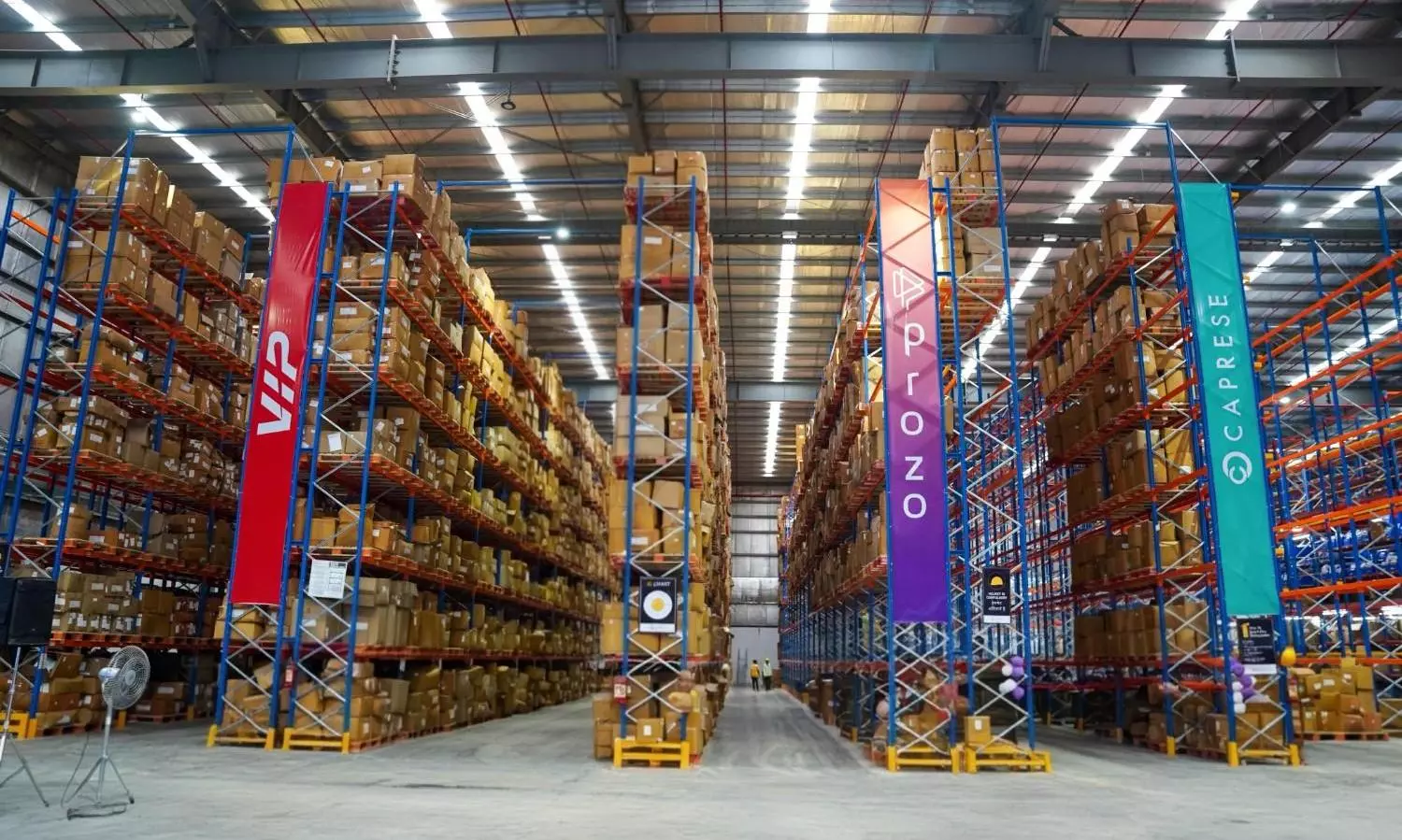
This shift is reshaping how brands think about warehouses themselves. Jakhar notes that facilities are increasingly viewed as dynamic components of a broader network rather than static assets. Location decisions are being driven by consumption patterns, with inventory positioned closer to demand clusters, even if that means operating smaller nodes with higher throughput expectations.
Turnaround time has become a commercial metric directly linked to customer experience and repeat behaviour. Flexibility now outweighs centralisation, reflecting an acceptance that volatility is structural rather than seasonal.
As a result, productivity has overtaken expansion as the primary source of competitive advantage. “Adding square footage without improving throughput only increases fixed costs and complexity,” Jakhar says. SLA adherence and execution efficiency matter more than the sheer number of facilities operated.
Investments in layout design, material handling, process standardisation and workforce efficiency compound over time, allowing networks to absorb volatility without constant capital expansion.
Container logistics re-engineered for reuse and density
Container logistics is also being reworked around utilisation rather than growth alone. Dhruv Taneja, Founder and Global CEO of MatchLog Solutions, points to a long-standing visibility gap between import discharge and export demand. “Container movement has often been treated as a series of disconnected legs,” he says.
MatchLog’s approach treats container movement as a continuous network, using real-time data on availability, location, condition and export bookings to create near-instant matches within industrial catchments. The aim is to ensure containers complete multiple productive cycles before returning to port, reducing empty repositioning and improving predictability.
Volatility has also altered how shippers think about capacity. Taneja notes that rigid contracts alone can no longer absorb uneven demand across seasons and trade lanes. Flexible capacity models built on shared infrastructure and dynamic allocation are gaining ground.
Network design is shifting away from linear, port-centric flows towards regional clusters where containers and transport assets can be redeployed quickly based on real demand signals. In this context, asset availability at the right place and time is becoming more valuable than ownership.
When peak cycles overlap, data becomes critical to execution. According to Taneja, real-time container and truck movement data allows inefficiencies to be identified and corrected as they emerge. Predictive insights help reduce idle mileage and waiting time, while digital execution systems replace manual coordination that struggles under sustained volume.
The result is improved utilisation without proportional fleet growth, alongside greater accountability through precise measurement of turnaround time, productivity and emissions.
A structural reset, not an operational tweak
Across fleet operations, fulfilment networks and container logistics, a common pattern is emerging. The system is moving away from episodic peaks towards continuous high utilisation, underpinned by technology and disciplined network design.
Over the next decade, Kanuganti expects logistics networks to narrow their focus. Rather than spreading capacity thin, operators will concentrate investment on fewer corridors that consistently perform, supported by technology-led planning and energy strategies built into route design. Jakhar, meanwhile, sees fulfilment networks becoming inherently omni-channel, with multiple nodes running at high baselines throughout the year.
In this model, automation and tighter links between planning and execution replace the temporary fixes once used to manage peak demand. From the container side, Taneja anticipates denser networks built around reuse, where digitisation, shared infrastructure and closer coordination between stakeholders form the backbone of everyday operations, not add-ons deployed in times of stress.
Together, these perspectives point to a structural reset in Indian logistics. The next phase of network design is not about handling occasional surges but about operating continuously without slack, where sustained intensity, data-led coordination and execution discipline become foundational rather than exceptional.