
Logistics associations meet GST Working Group; seek exemption for exim trade services
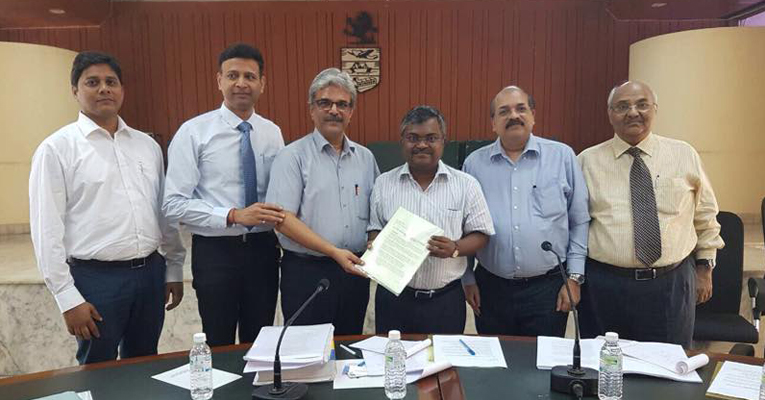


Apr 07, 2017: Logistics industry leaders from Federation of Freight Forwarders Associations in India (FFFAI), Air Cargo Agents Association of India (ACAAI), Association of Multimodal Transport Operators of India (AMTOI) and Consolidators Association of India (CAI) recently met J M. Kennedy, ADG DGR, Working Group, Transport & Logistics-GST in Chennai.
The Central Board of Excise and Customs (CBEC) constituted 'GST Working Groups' in March to interact with select industry sectors to address their concerns relating to GST implementation issues. Accordingly, the government designated officers to address issues relating to certain identified sectors like transport & logistics, to submit their report by April 10, 2017.
FFFAI was represented by Samir Shah, Chairman A V Vijaykumar, and Vice Chairman S Ramakrishna.
Welcoming the basic objective of the tax reformation called Goods and Services Tax (GST) as a revolutionary step, the associations maintained that there are certain provisions in the proposed GST law causing concerns for freight forwarding, customs broking, logistics services and manufacturing & exports industry in the country.
According to a release by FFFAI, the joint delegation emphasised on exemption from new tax burden to be levied by GST structure on the freight forwarding, customs broking and logistics industry as a whole, which hitherto have been exempted to make Indian manufacturing and export less expensive and competitive in the international market.
The association leaders pointed out that currently, there is no service tax for freight forwarding in the air and sea cargo segment, based on Rule 10 of the ‘Place of Provision of Service Rules 2012’, which provides that in respect of taxation on transportation of goods (other than mail or courier) criteria should be the ‘Place of Destination of Goods’. In the freight forwarding segment including air and sea cargo pertaining to export of goods from India, the place of destination is outside India and, as a result, Service Tax is not payable. This aspect was also confirmed by CBEC by a Circular issued on August 12, 2016.
However, the proposed GST law plans levy of GST on International transportation as well as freight forwarding which is in variance with the GST Provisions in other countries as well.
In addition, in the international air segment all airlines have registration in India and when a freight forwarder purchases an air freight slot/space from the airline, the tax would be applicable as per GST rate on services. Currently, there is no tax imposed on freight forwarders for the same.
The associations further observed that GST on freight forwarders will only be passed on to exporters resulting in exports from India to be more uncompetitive, defeating the objective of GST and ‘Make in India’. Similarly, levy of GST on import cargo would also result in double taxation (since on the entire freight, customs duties are being levied under Section 14 of the Customs Act) affecting re-export or Exim trade.
The GST Law indicates that SGST (State Goods and Service Tax) registration could be required in every state where there is a supply of goods or services or both. Currently, for service providers, the law provides for a centralised registration and compliance. The rule exists in view of the fact that logistics related services, especially in Exim trade, are different from the traditional manufacturing sector.
It has also been noted that under the GST regime supplier will have to file data online on 10th and 15th of every month and a monthly return on 20th apart from an annual return. This would mean 37 filings per state if statewise registration is implemented. In addition, if TDS and ISD is applicable there would be 61 filings in a year per State.
The associations suggested several recommendations, which include- International transportation of goods by all modes including freight forwarding should be zero rated; alternatively, both international transporting pertaining to that should be exempted; ancillary services related to international transportation of goods like customs clearances, warehousing, storage, cargo handling, packing, unitisation, port, airport, terminal etc should be zero rated or exempted; concept of centralised PAN based registration must be retained whereby service providers in the international transport segment can have a centralised registration and discharge applicable taxes through GST portal; the location of service provider should be the centralised registration address in the context of ‘Place of Supply’ provisions; and a single periodic return for the entire country should be implemented.
Photo Caption (L-R): Naveen Prakash from CAI; Vivek Kale from AMTOI; Samir Shah from FFFAI; J. M. Kennedy, GST Working Group; Vaitheeswaran, Advocate and Hemant Bhatia from ACAAI