
Intricacies of heavy lifts
10 Nov 2015 4:15 AM IST


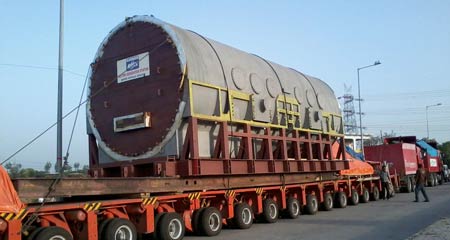
Project cargo which requires expertise in handling and moving oversized cargo has a huge potential in the Indian logistics industry due to growing infrastructural developments in India. Jasleen Kaur... Moving big, wide and heavy cargo has never been an easy task; the transportation of such cargo requires humongous amount of planning and expertise. Billions of dollars of project-critical equipment is shipped around the world annually. High levels of risk are associated with these shipments due to the nature of the cargo, transport logistics, and tight timeframes. Whether you are building a manufacturing plant, mining or drilling the earth, you will need to procure logistics transportation service to manage your cargo movement. With the rapid growth in infrastructure development in India, there is huge opportunity for those involved in project cargo. With the 4.7 million km of road network, 64,600 km of rail network and the coastline of 7,517 km; India has a huge potential. Infrastructure developments are continuously taking place coupled with key government projects. This has opened up new avenues for the Indian logistics industry. Seeing the potential, many industry players cannot stop themselves from exploring new market opportunities and one such segment considered as sunrise industry in the logistics sector is project cargo or sometimes called as ‘over dimensional cargo’ (ODC). This specialisation, which requires expertise in handling and moving oversized or hazardous cargo from origin to final destination, represents an important and growing facet of the logistics sector. As many economic activities like setting up of power plants, extension of existing refineries or urban infrastructure development across cities, they require heavy and oversized cargo to move from different places around the country or even move from overseas. Project cargo, according to the industry experts, is the transportation, handling and installation of heavy items which are indivisible, and weigh in the range of one tonne to over 1,000 tonnes and too large to fit into normal containers or onto conventional transporters. The heavy items could include wind turbine, refinery equipment, power components, and defence related equipments, etc. It could even be fragile and dangerous goods that need specialised handling. The market for heavy and oversized cargo is fast expanding on account of Indian government’s special thrust on developing infrastructure. Project cargo movement is rising in industries like power, oil and gas, mining etc. Government’s decision to attain self-sufficiency in power generation has resulted in the sanction of a slew of power plants to be set up across the country. Commenting on the position of ODC’s in the market, Arun Kachru, CEO, Associated Container Terminals (ACTL), says, “The ODC movement pertains to industrial developments especially in the power and refinery sectors. In the past 3-5 years, there has been a sudden surge in the power sector although 1-2 refineries are in the pipeline. The ODC packages, constituting equipment and machinery, allocated for these projects, are fairly large and they weight from 150 to 450 metric tonnes. The logistics of movement of such ODCs is rather intricate and dependent on the distance and the terrain to be traversed, and the dimensions and weights of the individual ODC.” ACTL is a private Inland Container Depot, mainly operating in North India. In 2011, Damco, world’s leading providers of freight forwarding and supply chain management services, successfully managed a 52 tonnes transformer shipment for a leading steel manufacturer from Kolkata to Berlin using a multimodal solution comprising of road movement and air by hiring Antonov 124, the world’s largest commercially viable cargo aircraft. Thomas Knudsen, CEO – Asia region, Damco, states, “The last five years or so have surely witnessed a boom in the Indian infrastructure industry particularly in the setting up of large scale power projects, installing of telecom equipments, setting up industrial plants in different sectors such as automobiles, cement, fertilizers, minerals and metals, as a consequence, demand for moving ODC. The manufacturing industry has witnessed a rising demand in both domestic and export market and in turn project cargo movement has increased.” Today there are many companies providing ODC transport facility to the customers, and they are specialising themselves to handle the complexities of ODC. The ODC transport industry is still growing and is fragmented, with lot of small companies to big players in the market. The sheer size of the goods calls for closer coordination between the manufacturers and transporters. Apart from the size, safety of the goods, the environment in some cases and people who are transporting as well as of areas through which the goods are transported are the major concerns for both the manufacturer and the transporter. The risk involved is very high and transporters use specialized containers or cargo transporters to move the goods. Dealing with a cargo of peculiar dimensions is always a challenge for a transporter. The loading and unloading of such cargo requires expert supervision, because of the greater risk of damage or accidents. Managing ODC, Knudsen feels that it is a complex task mainly because of the nature, size and the shape of the cargo. “Few aspects of the entire project execution involved activities such as pre-survey of transport routes, identification of the right equipment for handling/air lifting the cargo, preparing of the right set of documents for government purposes, obtaining in advance permission to move trailers at particular time on pre-defined routes so as to not disrupt the normal traffic, provide route escorts to handle any unforeseen contingencies, proper cargo lashing, insurance, in depth feasibility studies, loading and discharge supervision." Sharmila H Amin, managing director, Bertling Logistics opines, “Cargo with larger dimensions requires a completely different set of equipment, infrastructure, personnel and experience. The handling, storage, carriage and cost estimation, calls for a lot of prior planning and experience. Containers could be how the majority of the project movement is carried, but most of the attention is given to the ODC and heavy pieces e.g. boilers, heat exchangers, melting pots, crucibles, windmill blades, structures, monuments etc.” To reduce the handling and costs incurred by the importer this type of cargo should be received directly from shipside, said Amin. Adding further she said, “Accurate and complete dimensions of the cargo (length, width, height, and weight) are important. Certified location of all lifting points for the oversized cargo should be considered. The Government should incorporate the weighing measurement of the cargo (ODC & HL), through latest simulation software and measuring matrix.” Many challenges and issues need to be addressed while moving ODC especially through inland waterways like construction of jetties, barge design and construction, draft issues etc. India lacks road, rail and air connectivity to the regions where huge industrial projects are being constructed or installed. Also there is lack of technology and availability of equipment, trucks and container systems to handle these ODC. Knudsen mentions, “One has to depend on road transportation only as in India the coastal ways is neither well defined nor developed. Welcome boards/hoardings are not uniformly put. Very few are at a required clear height of 24 feet from the ground level where as many are placed just at 17 feet, making transportation of cargo height more than 12 feet very difficult. Many old bridges are decades old with no proper maintenance, which, makes the ODC/OWC transportation difficult. Eventually, an alternate bypass has to be constructed or the bridge reinforced.” “Though we now have better roads from many ports, there are always challenges for movement to a plant location. Often transit through busy city roads could be a cumbersome.So usually a road survey is conducted. The surveyor has the arduous task of checking for road medians, traffic signals, traffic islands, overhead obstacles, live wires, overhang etc. He also needs to see the condition of the road, its load bearing capacity and axle weight limitation, the capacity of the bridges/culverts en route to be able to take the weight/dimensions of the cargo,” said Kachru. Industry experts say ODC requires specialized equipment and detailed project planning to ensure effective execution. In India, inland waterways are not yet fully utilised for project cargo movement. Seeing the potential in the sector and the government’s adequate interest in the upliftment of this industry; logistics service providers dealing with container and bulk cargo too have entered this domain to obtain the benefits. Apart from this, various supporting industries have entered the Indian market to provide the required equipment, vehicles and infrastructure to handle the movement of ODC in and from India.

Next Story


