
FROM MAGAZINE: India’s maritime sector forges new opportunities
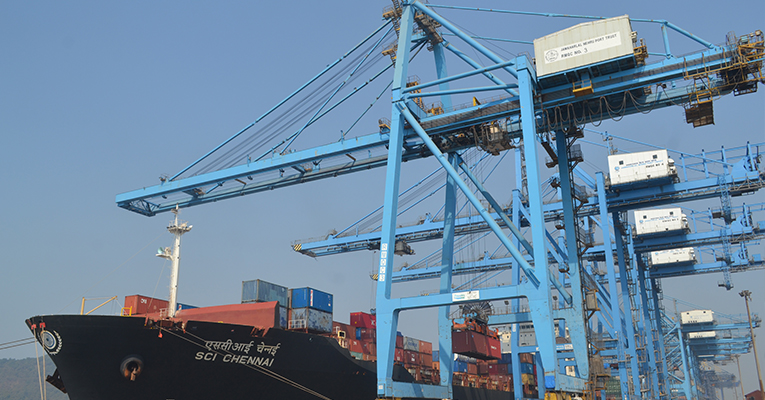


In a country where 95 percent of trading by volume and 70 percent by value is done through maritime transport, the importance of ports and terminals is significant. Since the country has the advantage to engage in trade and commerce through sea routes, the Indian maritime sector is constantly on the lookout for technologies and advancements to develop ‘smart ports’. Technologies such as real time track and trace, facilitating paperless transactions, big data, are all helping the industry to enhance security, lower the cost and deliver more for less. Twinkle Sahita
During April to September 2016, 12 major ports in India handled 315.4 million tonnes of cargo, showing a growth of 5.1 percent in comparison to the same period last year. Being a major manufacturing hub and the coastline of India running into more than 7500 kilometres, gives the country the advantage to engage in trade and commerce through sea routes. In the country where around 95 percent of trading by volume and 70 percent by value is done through maritime transport, the importance of ports and terminals is significant. It is currently serviced by 12 major ports and 200 notified minor and intermediate ports. According to the Ministry of Shipping, cargo traffic, which recorded 1,052 million tonnes in 2015, is expected to reach 1,758 million tonnes by 2017.
The Sagarmala Project, allowance of 100 percent FDI inflow, greater thrust on PPP projects, and the ´Make in India´ initiative have set a lot of optimism among the Indian as well as foreign players, who believe India is going to be a preferred destination for manufacturing and a major cargo generating and importing country in near future.
The Sagarmala project in particular, is being looked as an important strategic move by the Indian government to modernise its ports. It is an amalgamation of 150 projects categorised into port modernisation, connectivity, port-led industrialisation and coastal community development. The government plans to invest Rs 12 lakh crore for it under various programmes. At least 53 projects are expected to be undertaken to ensure the port handling capacity is increased by 1,000 million tonnes per annum. This includes six new mega port projects.
Since the last few years, the maritime sector has been sailing to new horizons. A shipper using seafreight to transport their product never thought the industry could come up with a solution to allow them to track and trace their products that are on the move. The Indian maritime sector is constantly on the lookout for technologies and advancements to develop ‘smart ports’. Technologies such as real time track and trace, facilitating paperless transactions, big data, are all helping the industry to enhance security, lower the cost and deliver more for less. ‘Smart’ stands for an intelligent exchange of data to boost the port’s quality and efficiency as an essential element of the supply chain.
Krishnapatnam Port is all set to go paperless by implementing ‘e-Xpressway’ for its container operations. A cloud based electronic platform; e-Xpressway has been developed by Gateway Media, which has provided a first-of-its-kind service by digitising the end-to-end documentation processes involving all the stakeholders of the maritime trade – vessel operators, container operators, terminal, custom house agents, freight forwarder, container freight stations, transporter, empty yards, etc, for export and import containers moving by both road or rail. e-Xpressway provides a cloud-based online access to all stakeholders for generating and processing forms and for getting the container in and out of terminal. Besides it also offers online approval of containers for customs and online form generation for export and import by road and rail. Each stakeholder can simply log in to e-Xpressway to complete their respective activities which will automatically push the activity to the next concerned stakeholder. The platform provides transparency and also enables QR code generation for easy scanning and processing the transactions at the terminal gate and thereby cutting the long queues.
Also, the port has installed Automated Fertiliser Handling System (AFHS) recently. The AFHS at Krishnapatnam Port is one of the most modern and technologically superior infrastructural set up which will be equipped to handle end to end fertiliser cargo operations right from the cargo discharge from vessel till evacuation by road/rail. A more reliable, economical and an all weather cargo handling solution, AFHS will enable the port to meet the increasing demand of imported fertilisers. Offering requisite efficiencies, flexibility and precision in operations, with the new system installed, the port is expecting to meet the needs of fertiliser importer in a smart and efficient manner.
India’s largest container port Jawaharlal Nehru Port in Navi Mumbai has implemented several initiatives to ease the complex handling processes. In 2016-17, the port took steps to facilitate paperless transactions, Direct Port Delivery (DPD) to all importers approved by customs irrespective of the volume criteria. RFID based gate systems to facilitate seamless movement, installation of container scanners, common parking lot for all terminals, conversion of parking plots into customs processing area, Inter Terminal Trailer movement (IIT), hassle free movement of the tractor trailers by bridging the gap between the peak and off-peak hours of CFS traffic movement, reduction in Imports Export Dual Time and single interface to integrate Import General Manifest and entry inwards with Import Advance List are some of the steps implemented to achieve efficiency at the port level.
Some of the direct benefits to the importer under DPD is prompt and timely delivery leading to reduction in inventory costs, saving transportation costs, saving handling and storage charges at warehouse, saving in container detention charges payable to shipping line, delivery of DPD container at port terminals 24x7 basis, reduction in dwell time for containerised cargo. DPD brings in savings in cost ranging from Rs. 8,000 to Rs. 20,000 and in time ranging from 5 days to 7 days.
Earlier every factory stuffed container was required to proceed to Container Freight Support to get customs approval and then proceed to terminal gates but after DPE, customs have started granting Let Export Order (LEO) from offices in the parking yard from May 2016. Documents are cleared at factory and containers do not have to wait at parking plots, entry of containers regulated by PIN and significant savings in time and cost for the exporter. Direct Port Export (DPE) service clears cargo in less than 2 days: JNPT Customs Systems is in place to clear 90 percent of cargo within four days. DPE enables about Rs 3000 to Rs 4000 of saving per container.
JNPT cargo operations were recently affected by the global ransomware attack that crippled several multinational firms. JNPT’s Gateway Terminals India (GTI), which is operated by APM Terminals, an AP Moller Maersk company, was shut for exports after the firm was affected by the ransomware Petya. However these cyber attacks affecting the biggest shipping line puts a question on the entire sector that claims to upgrade their IT systems to increase security in the operations. Maersk Line said its computer systems were among those hit by the global Petya cyber attack, causing it problems in processing orders and delaying cargo movements. AP Moller-Maersk said the cyber extortion, which has disrupted businesses around the globe, has also led to congestion at some of the 76 ports run by its APM Terminals unit, including in the United States, India, Spain and the Netherlands. Analysts believe that it is crucial that the maritime companies should take Maersk’s case as a lesson, and create more robust and resilient systems – otherwise this will not be the last time we see such challenges.
Ergo, the maritime industry has not yet reached its full potential and a whole lot of worthwhile opportunities lay ahead for its ports and terminals.
Recently Dubai based global trade enabler DP World signed a Memorandum of Understanding (MoU) with the National Investment and Infrastructure Fund (NIIF) to develop projects spanning the port and logistics sectors including opportunities under the Sagarmala initiative.
“Initiatives to promote ease of doing business have brought about a significant change in the business environment in India, attracting foreign investors who are now keen to invest in India and grow their businesses here. Particularly relations between the United Arab Emirates and India have flourished under the current government led by Prime Minister Narendra Modi. During the various visits of the Crown Prince of Abu Dhabi Mohammed Bin Zayed Al Nahyan to India in the last two years, and Modi’s visit to the UAE, there were discussions regarding long term investments by both countries,” said the company through a statement. DP World, which operates two of the four terminals at JNPT, has plans to invest over $1 billion in India for augmenting its port-related operations.
“Jawaharlal Nehru Port Trust’s (JNPT) Board is mulling to invest a minimum of Rs 1,000 crore as part of its latest expansion plan, wherein it may either build a new port or buy an existing one on the Western Coast, even under-construction ports are being considered for acquisition according to sources. To meet customer demand, JNPT has a major expansion plan, doubling of capacity through deepening of existing and construction of the new 4th terminal, substantial investments in road infrastructure to improve connectivity with the hinterland.”
“The JNPT Special Economic Zone (SEZ) that is already seeing interests from some big global manufacturers. Led by a sharp vision, targets set by the government 2-3 years ago and a systematic monitoring of critical projects at the highest levels, JNPT is riding the facilitative environment and the sense of urgency that the Indian government is putting on the port sector. Nitin Gadari, Minister for Road Transport and Highways and Shipping, laid the foundation stone for eight connectivity projects worth Rs. 1117.03 crores at JNPT in May 2017. A series of projects have been planned and it will enhance connectivity of the hinterland to JNPT. Huge investments are also expected under the Sagarmala project which will lead to better infrastructure,” informs the company in an interview to Indian Transport & Logistics News (ITLN).
Jawaharlal Nehru Port handled 4.50 million TEUs (4,500,150 TEUs) of container traffic during the financial year 2016-17, which is the highest ever container traffic since inception of the port. The growth in container traffic is 0.19 percent over the previous year’s container traffic of 4.49 million TEUs (4,491,568 TEUs). Port also handled 6.78 million tonnes of liquid traffic which is 4.25 percent higher than the previous year’s 6.50 million tonnes. Port handled 0.82 million tonnes of dry bulk (Cement) as compared to 0.67 million tonnes in previous year, registering growth of 21.01 percent.
Exports from India outpace imports in Q1 2017 The combination of a large pool of engineers, a strong IT presence along with English as the language for business will ensure that India becomes a preferred place for manufacturing. India also has the added advantage of a relatively lower cost of manufacturing with strong design and engineering capabilities.
India has had a strong manufacturing base with the initial investments by major chemical, pharmaceutical and engineering companies. Examples are Bayer, BASF, Hoechst, Ciba Geigy, Roche and Mercedes, Fiat/Premier and Uhde. India also had a very strong textile sector which has undergone a change from integrated textile mills in Mumbai and Ahmedabad being replaced by power looms in Bhiwandi and Surat.
The large, younger population with increasing consumer spending, coupled with one of the strongest savings globally, is a very attractive market for all sectors of goods and services.
India is a significant exporter of both packed chemicals and liquid bulk. The auto sector has moved from the Fiat/Premier to Maruti Suzuki, Renault, Hyundai and home grown companies like Tata Motors and Mahindra. All of them import steel for their bodies and other parts critical to the functioning of their vehicles. The strong boom in the pharma sector has led to India developing as a global supplier of generics and APIs.
According to the latest report released by Maersk Line, India’s export-import container trade volumes have grown by 7 percent in the first quarter of 2017 as compared to 10 percent in the same period last year. The slowdown has been due to a short-term decline in imports. While the container export volumes have registered a growth of 8 percent in Q1, same as the year before, import growth volumes declined to 5 percent against 13 percent in Q1 2016. The highest growth in export volumes has come from India’s sub-continent neighbour, Sri Lanka, where the demand for metals, stones, sulphur and plaster has propelled to fulfil ongoing infrastructure development projects.
The country’s growth performance has indeed been stronger than global trade, which in the past two quarters has increased to around 4-5 percent, driven by improvements in exports to regions such as Far East, North America and Latin America, says the report. Franck Dedenis, head of West Central Asia Trades, Maersk Line, cited piling up of inventory in the market post demonetisation and lack of clarity around Good and Service Tax as the reasons for the decline in imports in the first quarter of 2017. However, now post GST implementation from July 1, it is likely to improve. With the introduction of GST, India becomes a seamless market without any difference between inter-state or intra-state sales. This will facilitate structural redesigning of the logistics network. Service providers would be incentivised to create hub-and-spoke supply chain networks by operating large central warehouses and remodelling transportation routes.
Interestingly, Indian refrigerated cargo has been growing consistently with the demand for commodities like vegetables, meats and sea food on the rise. Infact, India has consolidated its top spot as the largest exporter of beef to Vietnam. “Although, Vietnam is the biggest buyer of Indian beef, it is just a destination market and from Vietnam Indian beef finds its way into China where the consumption is very high. Lower prices, along with the proximity to key markets in Southeast Asia and West Asia, gives a huge competitive edge to Indian buffalo meat exports,” avers Dedenis.
He added, “To stay ahead in technological innovation in refrigerated containers, Maersk Line recently became the first shipper to invest in Star Cool reefers by Maersk Container Industry (MCI) which will help power cold chain transparency and raise the Industry standards in the segment.”
Analysing the current scenario, we find the need to have more facilities for cold chain storage. “Cold chain storage and integrated distribution centers should also be set up at various strategic locations in the country. The warehousing facilities that are built as a part of these projects must push the boundaries to technology and innovation to cater to more value-added services,” states DP World.
Surprisingly, pharmaceutical exports have registered a negative growth in Q1 2017. There is an unclear picture whether this temperature sensitive commodity has been seeing a modal shift from sea to air.
India’s key trading partners Germany is India’s most important trading partner in the EU and its sixth worldwide. India occupies 25th place in the German foreign trade league, being 28th for imports and 27th for exports. As a supplier Germany takes 8th place in India, being 5th as a customer for Indian products.
Last year seaborne container traffic between Hamburg and India grew by two percent. With volume handled at 240,000 TEU (twenty foot equivalent units), the South Asian country is among Hamburg’s top ten trading partners. Axel Mattern, CEO, Port of Hamburg, said, “The main goods imported from India are chemical products, metals and metal products, along with textiles, clothing, leather and leather goods. As the main export goods, machinery, equipment and household appliances, metals and metal products, as well as chemical products, are shipped to India via the Port of Hamburg.”
Port of Antwerp has opened new training centre at JNPT. “The India training centre is a collaborative initiative between APEC - Antwerp/Flanders training centre and the Ministry of Shipping. Investment decisions are undertaken by a subsidiary of Antwerp Port Authority, Port of Antwerp International (PAI). India along with Middle East, Africa, South East Asia and Brazil are strategic growth markets for PAI. In the future, should an attractive proposal arise, PAI will consider it,” said Malini Dutt, Representative for India at Antwerp Port Authority. The port has recorded the best first quarter ever this year, both for total overseas freight and for containers. February has been the best month for containers that has ever been recorded in the port of Antwerp. The port of Antwerp handled 54.3 million tonnes of freight during the first three months of this year, 1.5 percent more than in the same period last year. The further growth was mainly due to container freight, which was up by 2 percent in terms of tonnage. Challenges
One of the main challenges that when solved will allow India to handle more cargo efficiently is the high cost of logistics in the country. This can be done by developing multi-modal logistics parks and transport infrastructure that creates and links rail, road, coastal and airlines infrastructure. This will also include the refurbishment of highways, railways, and rural roads, and reviving unused airstrips, logistics parks, and inland waterways. Initiatives like the Sagarmala and Bharatmala are focused on engineering these vital projects.
The way forward India with vast potential in maritime trade has introduced new systems and solutions to change the dynamics of the seafreight sector. Direct Port Delivery, Direct Port Export, IT developments such as facilitation of electronic processes, promoting green energy, Inland Waterways & Coastal Shipping development led by the industry contribute to make the sector more vibrant and increase its efficiency. In fact, as per Prime Minister Narendra Modi, the sector has huge potential to become, “the engine of growth” for India.