
Developing new routes
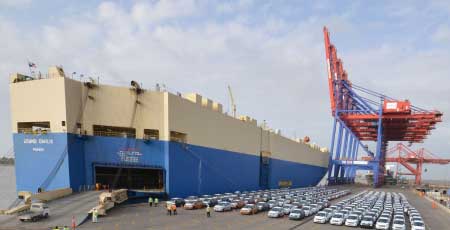


The port sector in India has witnessed significant growth in the recent past. The Ministry of Shipping estimates around 95 percent of India's trading by volume and 70 percent by value is done through maritime transport which spells out the importance of ports in India's Export Import (EXIM) trade. Deeba Kazi
India’s maritime sector plays a vital role in sustaining growth in the country’s trade and commerce. India has 12 major and 187 non-major ports. Cargo traffic, which recorded 1,052 million metric tonnes (MMT) in 2015, is expected to reach 1,758 MMT by 2017. According to India Brand Equity Foundation (IBEF), India is the 16th largest maritime country in the world, with a coastline of about 7,517 km. The Indian minister for Shipping, Road Transport and Highways, Nitin Gadkari, announced a massive investment in India’s ports, which is likely to help boost the country’s economy. The Indian government plans to develop 10 coastal economic regions as part of plans to revive the country’s Sagarmala project. The key objective of the Sagarmala project is to develop port infrastructure in India that results in quick, efficient and cost-effective transport to and from ports. It also includes establishment of rail/road linkages with the port terminals, thus providing last mile connectivity to ports; development of linkages with new regions, enhanced multi-modal connectivity including rail, inland water, coastal and road services. A number of measures have been adopted to boost the maritime sector of India. A memorandum of understanding (MoU) has been signed between the Inland Waterways Authority of India (IWAI) and Dedicated Freight Corridor Corporation of India (DFCCIL) to create logistics hubs with rail connectivity at Varanasi and other places on national waterways. The joint development of state-of-the-art logistics hubs at Varanasi and other areas would lead to the convergence of inland waterways with railways and roadways, thus providing a seamless, efficient and cost-effective cargo transportation solution. According to a report by IWAI, inland waterways have become one of the key enablers of economic development. Inland Water Transport (IWT) has tremendous potential for cargo movement and tourism. The excellent environmental credentials, the high safety standards for shipments and the large carrying capacity of the vessels are just some of the outstanding features of this long standing mode of transport. Talking about the development of inland waterways in the report, Brijesh Lohia, MD, Global Ocean Group explains, “India’s inland waterways today still haven’t reached its full capacity by any stretch of imagination. Today, private sector needs to chip in with investments for overcoming the hassles in IWT. If it has to emerge as vibrant and flourishing centre for fostering large scale cargo movements and commercial use, a number of steps need to be taken which also includes a strong logistics department to make that movement.” Global Ocean Group is engaged in door delivery solutions in all modes of transport from international freight to local transportation facility including customs clearance and warehousing. Increasing investments and cargo traffic point towards a healthy outlook for the Indian ports sector. However, when it comes to the country’s Roll-on-Roll-off (RoRo) infrastructure, it has not matched the growth in exports, and lags behind that found in other Asian markets including China, Thailand and Indonesia. Although there are Ro-Ro facilities and vehicle storage at both Mundra Port, in the western state of Gujarat, and on the east coast at Ennore Port, 20km from Chennai in the southern state of Tamil Nadu, no ports have dedicated terminals offering a full range of services for exports. It is said that both ports have storage and traffic constraints. The other three Ro-Ro ports include Mumbai, Kolkata & Chennai which lack dedicated Ro-Ro facilities and have many infrastructure constraints. Containerised exports often go from Jawaharlal Nehru Port Trust (JNPT) near Mumbai. The port of Chennai is India’s largest vehicle export hub thanks to Hyundai’s production facility near the city. However, Chennai port has space issues. Conversely, in a move that could boost trade along the country's coastline, APM Terminals Pipavav received its first domestic Ro-Ro shipment of 800 Hyundai cars from Chennai port in February this year. The development is also likely to decongest rail and road traffic. The cars, which are destined for western India dealerships, originated at Hyundai Motor India’s (HMIL) manufacturing facility near Chennai. The development follows Ministry of Shipping's decision to relax cabotage regulations on special vessels under which foreign flagged Ro-Ro vessels can ply on domestic coastal routes. APM Terminals Pipavav, part of the APM Terminals Global Terminal Network, said in statement that it was "pioneering use of economical and environmentally-friendly coastal transportation of Indian-manufactured automobiles". The company said modal shift incentives currently under evaluation by the Indian government will further encourage shifting of domestic cargo from road to sea. The government has earlier said the availability of Ro-Ro vessels is essential for success of efforts to develop coastal shipping and decongest roads and railways. So far, the cabotage policy in India allowed first preference to Indian flagships over cargo and foreign ships. Cargo and foreign ships were allowed only when no suitable Indian flag vessel was available for the same. Indian importers and exporters use Colombo, Salalah, Singapore and Dubai hubs for shipments adding to their costs. At present, around 60 percent of India's exports and imports containers are transshipped through ports like Singapore and Colombo. This transshipment through ports outside the country involves not only huge expenditure but also takes extra 7-10 days of transit time. As part of its Mission Resurge, Chennai Port Trust has introduced a dedicated Ro-Ro service to Colombo in a bid to improve its export volumes. According to reports, a Ro-Ro vessel carried a consignment of 67 trucks of Ashok Leyland to Colombo in its maiden service recently. Sri Lanka is one of the key export markets for Ashok Leyland and the company has established a strong presence in the island nation. The company has set a five-year target of achieving 25-30 percent of volumes from exports. There is already heavy competition between Chennai Port and Kamarajar Port in car exports. Together, they handle four lakh vehicles per annum. For years, Chennai Port was leading in car exports. In a bid to reduce the burden of over 10,000 Goa and Konkan bound vehicles on city roads, the Mumbai Port Trust (MbPT) has awarded the work order for the Ro-Ro water transport services terminal at Ferry Wharf (a wharf along the Thane Creek, along the coast of Dockyard Road on the Eastern seafront of Mumbai), even as similar development is underway at Mandwa in Alibaug by the Maharashtra Maritime Board (MMB). One Ro-Ro service will be able to carry over 300 passenger cars or about 100 trucks. “It will not only help save almost one hour of travel time as well as fuel, but also cut vehicular pollution," said MbPT chairman Sanjay Bhatia. The MbPT has also decided to issue tenders for a Rs 54-crore project to upgrade and modernise the cruise terminal at Indira Docks in Mazgaon, Mumbai which currently handles both cruise liners and cargo ships. The Mumbai port receives around 6,000 international ships every year, barges, luxury yachts and ferry services. Eventually, when the CIDCO terminal towards Nerul comes up, most of the traffic will be diverted via Ro-Ro vessels and catamarans, according to reports. The City and Industrial Development Corporation of Maharashtra (CIDCO) is a city planning organisation created by the Government of Maharashtra. Including MbPT, Cidco and MMB terminal facilities, the project is expected to cost Rs 1,000 to Rs 1,200 crore with each agency spending around Rs 400 crore. Approximately 1.8 crore people use water transport annually across the state. The Maharashtra State Road Development Corporation was initially entrusted with executing Ro-Ro services project, but it was later handed over to MMB.