
NMIA welcomes Queen of the Skies, its first B747 freighter
National Airlines B747-400F N569CA from Frankfurt Hahn is NMIA's largest aircraft yet, following IndiGo, Afcom, and Hong Kong Air Cargo freighter launches this month.
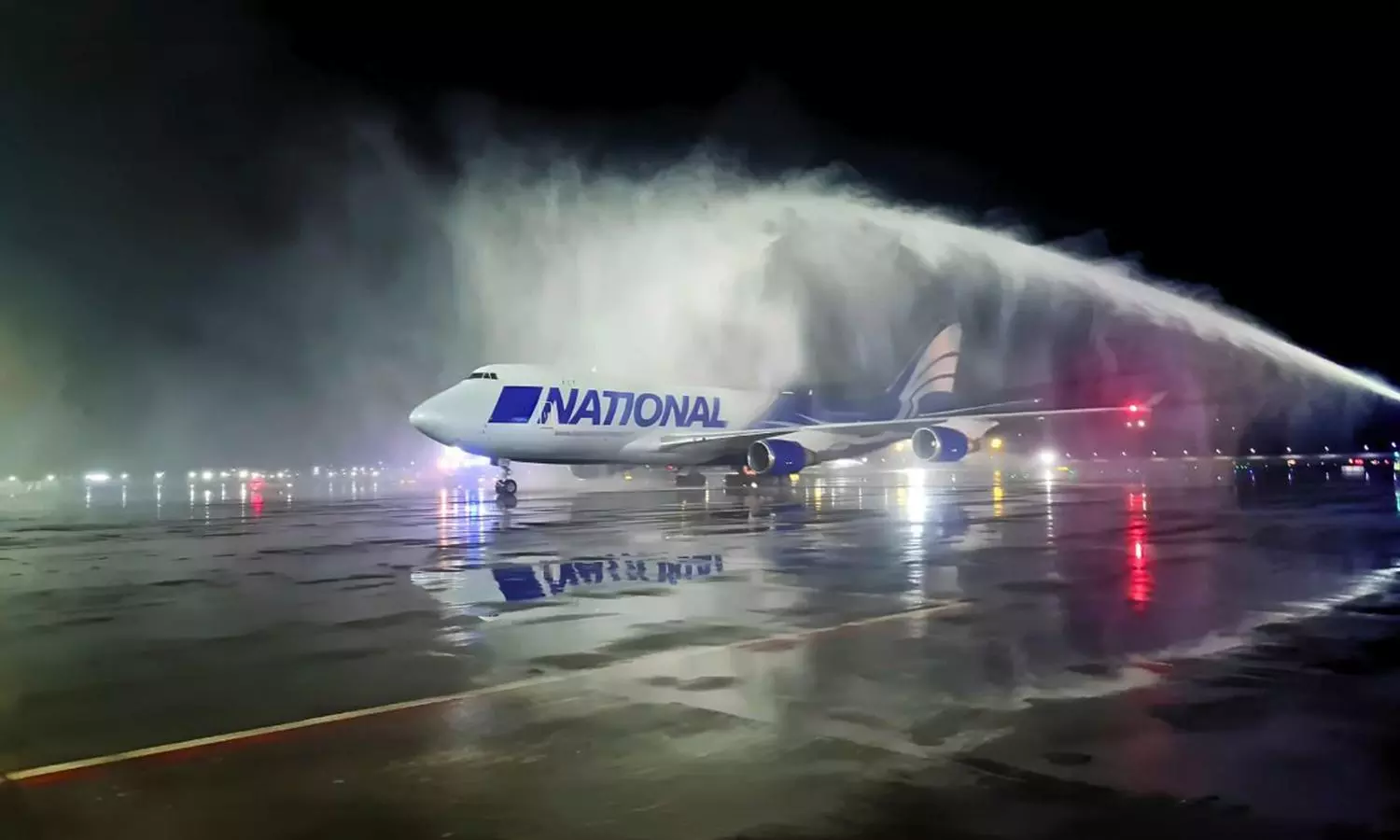
National Airlines B747 freighter receives a water cannon welcome at NMIA (Photo: NMIA)


Navi Mumbai International Airport (NMIA) gave aviation’s most iconic freighter a ceremonial water cannon salute in the early hours of Monday, August 24, as a Boeing 747-400F touched down from Frankfurt Hahn, the largest aircraft to land at India's newest airport since it opened.
The quad-engine widebody, registered N569CA and operated by Orlando-headquartered National Airlines, arrived from Frankfurt Hahn Airport, a key European freight gateway. The landing marks the entry of the Boeing 747 freighter, often dubbed the "Queen of the Skies", into NMIA's still-young cargo operations, underscoring the pace at which the Adani Group-CIDCO joint venture is scaling up as a freight hub for western India.
Ground handling for the inaugural 747 movement was not without challenges. Reports indicate that offloading was delayed due to technical issues, including problems with ground support equipment (GSE). These delays in turn triggered Flight Duty Time Limitation (FDTL) restrictions for the crew. As a result, the aircraft departed NMI with pallets that had arrived on the flight returned back as stacked cargo.
Such teething issues are not unusual for a greenfield airport handling a new and considerably larger aircraft type for the first time, and are expected to ease as ground handlers and airport systems adapt to widebody freighter operations.
The arrival of the 747F on August 24 capped a swift, month-long progression in NMIA’s freighter capability, advancing through three distinct classes of cargo aircraft in just a few weeks.
It began on August 1, when IndiGo CarGo’s Airbus A321 P2F (VT-IKX) departed for Sharjah on a Bengaluru–Navi Mumbai–Sharjah–Delhi rotation, having flown in from Bengaluru earlier that day. Confirmed as a regular non-scheduled service carrying general cargo and perishables, the flight marked NMIA’s first narrowbody freighter movement.
By August 16, the airport had stepped up to widebody freighter capability as Hong Kong Air Cargo became its first foreign carrier, launching a dedicated Airbus A330-200F service linking Hong Kong and Navi Mumbai.
On the same day, Afcom Cargo became the second Indian cargo airline to operate international freighter services, flying a Boeing 737-800F from Dubai (DWC) to NMI, followed by a return flight the next day. Afcom has since committed to three weekly freighter rotations between NMI and Dubai’s DWC airport.
Finally, on August 24, National Airlines’ Boeing 747-400F touched down from Frankfurt Hahn, introducing quad-jet widebody freighter capability and setting a new benchmark as the largest aircraft to land at NMIA to date.
National's Boeing 747F is the largest aircraft to land at NMIA since it opened (Photo: NMIA)
The progression from narrowbody, to medium-haul widebody, to quad-engine jumbo reflects how quickly the airport’s cargo profile is diversifying, barely eight months after NMIA’s first commercial passenger flight landed on December 25, 2025.
The push to build up freighter capability at NMIA traces back to a runway and apron rebuild across the harbour at Chhatrapati Shivaji Maharaj International Airport (CSMIA). Mumbai International Airport Limited (MIAL) had flagged the issue as early as 2025, but confirmed in a December 2025 notice that Apron "G", the dedicated freighter apron, would be unavailable from August 2026 to May 2027 for a full pavement reconstruction, alongside work on a new taxiway to boost Runway 14/32 capacity. With no alternative apron available due to space constraints and continuous passenger operations, MIAL said dedicated freighter flying at CSMIA simply would not be possible during the closure, pointing operators toward the newly opened NMIA instead.
The scale of what’s being displaced is significant: CSMIA handled 860,000 tonnes of cargo in 2025, of which freighters accounted for nearly a third. Industry voices have cautioned, though, that shifting that volume takes more than just available tarmac: freight forwarders, customs brokers, ground handlers and road connectivity all need to mature in parallel at the new airport.
The move has not been without friction. US authorities were reported in May to be pushing back on the relocation plan, warning that compelling carriers such as FedEx to shift operations to NMIA could run afoul of the US-India Air Transport Agreement, with Washington reportedly concerned the shift was less about runway works and more about steering traffic to the new airport.
Cathay Cargo confirmed in July that it would move its Mumbai freighter operations to NMIA while its tri-weekly summer service continued uninterrupted, with Air France and Lufthansa Cargo reported to be weighing similar moves; even as sources cautioned that NMIA’s infrastructure and manpower were still catching up to a full-scale freighter shift.
Against that backdrop, the back-to-back arrival of a narrowbody, a medium-widebody and now a 747 freighter within a month signals that NMIA is being tested, and is responding, as a genuine alternative cargo gateway for the Mumbai Metropolitan Region, even as it works through the operational gaps that come with any new hub scaling up to handle the industry’s largest freighters.


