
Asia Pacific air cargo rises in Jan but capacity shows fatigue
Strong flows on Europe–Asia and intra-Asia trade lanes, boosted by Lunar New Year shipping activity, helped sustain momentum despite ongoing weakness on the Asia–North America corridor.
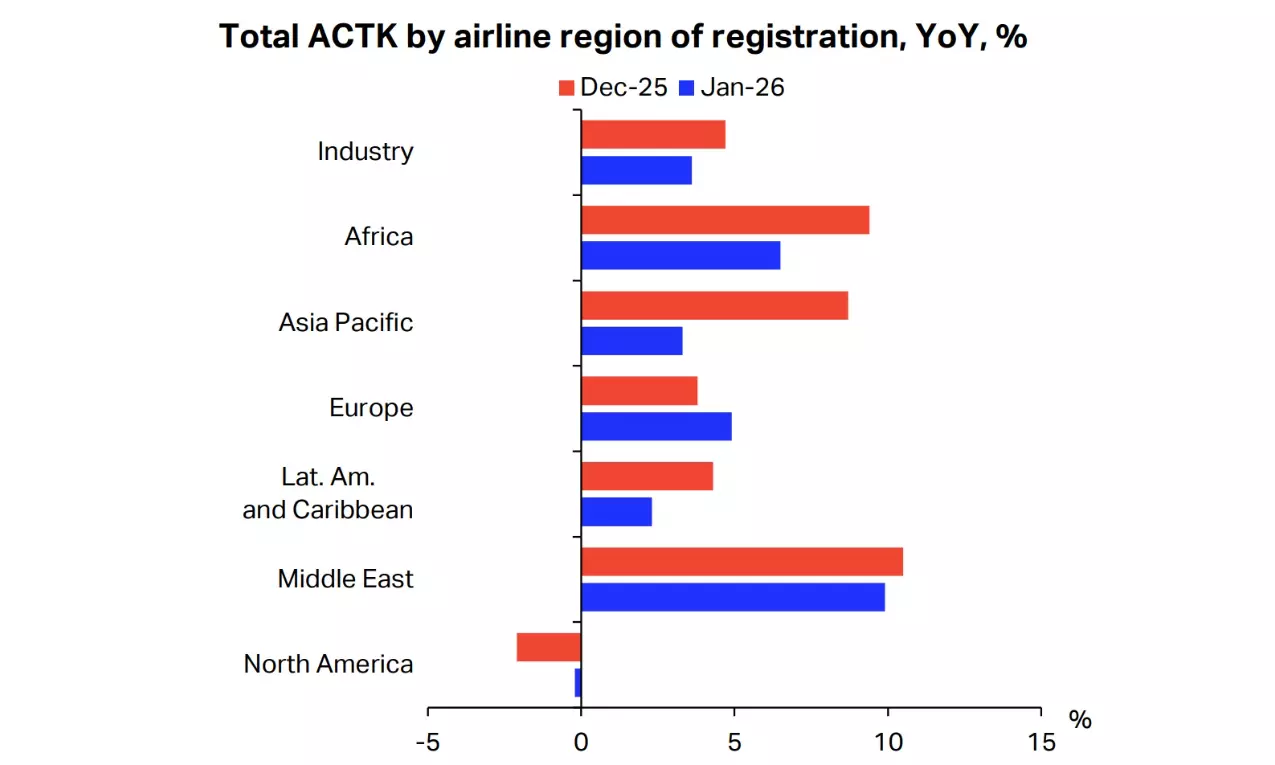
All regions contributed to the capacity increase except North America, where supply contracted by 0.2%


Asia Pacific remained the largest air cargo market in January 2026, with demand rising 7.8% year-on-year, outpacing the global average of 5.6%. Capacity in the region reached record January levels, though its growth rate was the weakest since 2020, signalling signs of capacity fatigue. Strong flows on Europe–Asia and intra-Asia trade lanes, boosted by Lunar New Year shipping activity, helped sustain momentum despite ongoing weakness on the Asia–North America corridor.
Meanwhile, global air cargo demand, measured in cargo tonne-kilometres (CTK), rose by 5.6% in January 2026 compared to January 2025 levels (+7.2% for international operations), according to the data released by the International Air Transport Association (IATA). Capacity, measured in available cargo tonne-kilometres (ACTK), increased by 3.6% compared to January 2025 (+5.7% for international operations).
“The demand for air cargo had a robust start to 2026, recording 5.6% year-on-year growth in January. At the regional level, the story is more polarised. Carriers in Africa, the Middle East, Asia-Pacific, and Europe all reported faster growth than the global average. In contrast, carriers in the Americas reported aggregate contractions.”
“The resilience of air cargo will continue to be tested in the coming months. In addition to the long-running uncertainties of evolving US trade policies, the outbreak of hostilities in the Middle East will both weigh heavily on global supply chains. Addressing these topics will add extra importance to discussions at the upcoming World Cargo Symposium in Lima, Peru (10-12 March 2026), where strengthening air cargo’s adaptability and efficiency through digitalisation and other measures will be a key focus,” said Willie Walsh, IATA’s Director General.
Several factors in the operating environment should be noted: the global goods trade grew 4.9% year-on-year in December 2025, while jet fuel prices fell 6.5% in January and global manufacturing sentiment strengthened as the PMI rose to 51.8, its highest in over a year and a half.
The PMI for new export orders climbed to 49.9, slightly below the growth threshold but the highest in 10 months, reflecting mixed but cautiously optimistic industrial growth.