
The Bharat factor: India’s rise in global automotive supply chain
With booming exports, advanced localisation and bold sustainability shifts, India is fast becoming a pivotal hub in the global auto supply chain.
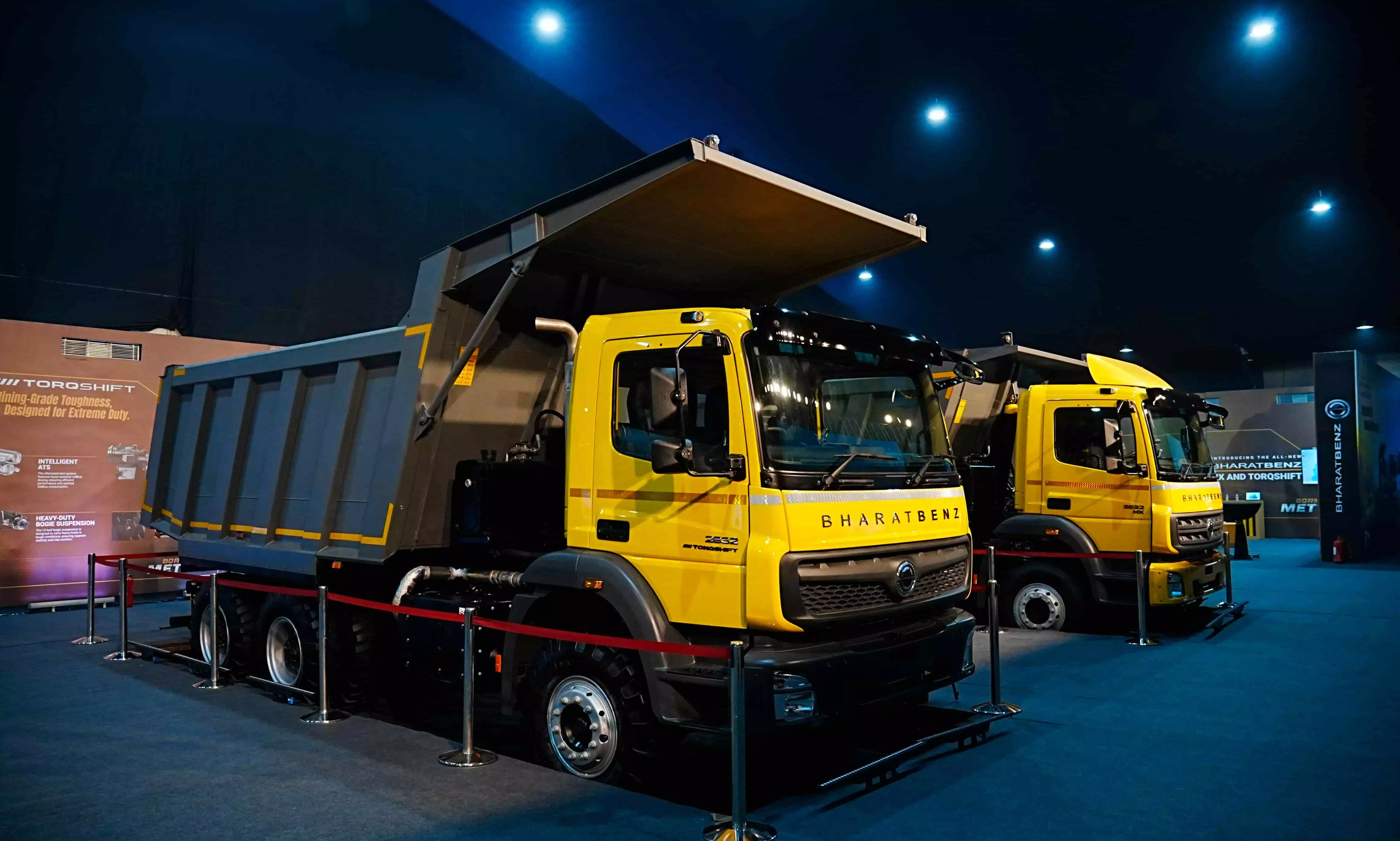
In July 2025, DICV launched two new BharatBenz construction-mining trucks from its Oragadam plant in Tamil Nadu.


For decades, the architecture of the global automotive industry was taken for granted: German engineering, Japanese production discipline, American scale and, in the last two decades, China’s unrivalled factory capacity. Over the past ten years, however, that map has quietly shifted. India — long spoken of for its demand-side potential — is now stepping forward as a fundamental supply-chain node. It is doing so not through one-off advantages but through a sustained assemblage of engineering talent, supplier capability, logistics connectivity, and policy frameworks that together tilt the economics and resilience equations for manufacturers and suppliers worldwide.
The story here is not only about one company or one plant; it is about an ecosystem that now supports giant global OEMs and tier-one suppliers, tyre makers and luxury assemblers, and which is already steering global decisions about where and how next-generation vehicles are designed, made and exported.
India as a strategic, not just a cost, location
When Daimler Truck announced during its Capital Market Day 2025 that India had been designated as the “best cost country” within the Mercedes-Benz Trucks ONE global team, it was notable not because the company found a new low-cost site but because it publicly acknowledged India’s strategic depth. That depth combines cost advantage with a high level of engineering skill and a supplier base capable of meeting world-class specifications. Michael Moebius, President and Chief Procurement & Supply Chain Officer at Daimler India Commercial Vehicles (DICV), captures this mix succinctly: “One of our biggest advantages here in India is low cost but high education level. And we have a very young and agile workforce in all areas — in our production, in our R&D. And this is exactly what we are utilising worldwide.”
Moebius’ comments are significant not simply for their praise of India’s workforce, but because they reflect a careful operational decision: to move beyond buying low-cost goods and to embed India into design, testing and global component production. He stresses the integration of India’s engineers into Daimler’s global R&D network: “Our R&D engineers, they are networked with the R&D engineers across the globe. So there’s a regular exchange. And also orders are given for us to design to test. And we are also producing here. For example, our global medium transmission is exclusively produced in India for the world.”
Beyond the Daimler example, other industry leaders confirm the same structural shift. Sahil Seshadri, Head of Global Sourcing for India & Southeast Asia at Knorr-Bremse Systems for Commercial Vehicles, frames the change in procurement terms: “India for India and India for Global. Localisation is prioritised for domestic growth while positioning India as an export hub for global supply chains.” Knorr-Bremse — a supplier of braking systems and other safety-critical components — is not merely shifting production; it is building the supplier development and risk-management programmes required to qualify Indian sources for export to demanding markets.
“DICV will produce and sell 60,000 trucks by 2030, for both domestic and export markets.”
Michael Moebius, Daimler India Commercial Vehicles (DICV)
From tyres to luxury interiors, the evidence is multiplying that India can deliver more than price. Debashish Roy, Chief Digital Transformation Officer at CEAT, explains how the tyre maker’s export business has matured: “Customers abroad now see Indian tyres as technologically competitive, not simply cost competitive.” He points to CEAT’s improvements in forecasting, container planning and plant scheduling as enablers that raise serviceability and lower total landed cost for international buyers.
Luxury vehicle programmes too are changing stance. Pratik Chakraborty, a supply-chain lead at a global luxury OEM operating an Indian CKD (completely knocked down) assembly model, explains that suppliers and packshops have been adapted to meet European and global quality and sequencing requirements. “Five years ago, the idea of sourcing high-precision interior parts, lighting modules or machined aluminium components from India for our global models would have been met with hesitation,” he admits. “Today, it is not only feasible — it is increasingly becoming our strategy.”
Taken together, the executives’ perspectives tell a single story: India’s role in global automotive value chains has expanded from being a market to being an indispensable manufacturing and sourcing node.
Scale, production and exports: The numbers that underpin the change
The narrative is backed by scale. According to the India Brand Equity Foundation (IBEF), total vehicle sales in FY25 reached 25.6 million units, supported by strong production depth and fast-expanding export capacity. Passenger vehicle sales stood at 4.3 million, commercial vehicles crossed 1 million, and two-wheelers dominated with 76.57% of the market. India also exported over 5.3 million vehicles, including 4.19 million two-wheelers, underscoring its expanding global footprint.
Production momentum reinforces this growth. In June 2025, India manufactured 2.36 million units, up 17% from June 2023, with industrial clusters across Tamil Nadu, Gujarat, Maharashtra, Karnataka and Haryana enabling scale for both domestic demand and export-led manufacturing. Investor confidence is evident in cumulative FDI inflows of Rs. 2.48 lakh crore into the sector between 2000 and 2025, while analysts project strong EV and battery market investment through the decade.
A view of Knorr-Bremse’s Pune plant, a key hub for commercial vehicle braking component production.
India’s export story is becoming more global in scope. Shipments to Europe surged nearly ninefold to Rs. 559 crore between April–August FY26, while exports to Japan climbed almost fourfold. Automakers are placing India at the centre of their global strategies: Suzuki has committed Rs. 67,478 crore to expand capacity to 4 million units by 2031 and has already exported 7,400+ eVitara EVs to Europe. Honda has designated India as the manufacturing base for a new EV destined for Japan and other Asian markets.
Between April and October FY26, India exported 5.14 lakh vehicles, already 67% of FY25’s total. South Africa remained the top destination with shipments worth Rs. 11,004 crore, followed by Saudi Arabia, Mexico, Japan and the UAE. Complementing this, India’s auto component exports reached Rs. 2.03 lakh crore in FY25, with Europe accounting for 29% of demand.
DICV’s Oragadam plant: A microcosm of India’s capability
If we examine a concrete example, DICV’s Oragadam plant in Tamil Nadu showcases the elements that have changed global calculation. The facility spans 400-plus acres and produces BharatBenz trucks for India, while simultaneously building and exporting FUSO, Mercedes-Benz and Freightliner trucks to more than seventy global markets. The plant began production in 2012 and exported its first fully built truck in 2013 — a strikingly rapid move from commissioning to exports.
Moebius highlights the logistics and geographical advantages: “With our plant very close to the harbour here in Chennai, we have short logistics ways. The majority of our suppliers are out of the region and that gives us short ways and, you know, ways on the road is money. This logistics cost we wanted to keep as efficient and as low as possible.”
Those short logistics distances are not incidental. Chennai is the hub of a dense supplier belt: engines, axles, pressed parts, electronics and cab interiors are all produced within a radius that makes just-in-time (JIT) and just-in-sequence (JIS) supply feasible. Moebius explains that sea freight is the “primary transportation mode” for both completely built units (via roll-on/roll-off vessels) and for CKD kits packaged into containers. Air freight, by contrast, is used sparingly and only as a contingency: “Air is somehow like a contingency plan. If, for example, a part is delayed... we ship it by air to avoid a production stop somewhere around the globe. But this is very, very rare.”
The plant’s export track record is tangible. Moebius states plainly, “We have exported in total 70,000 units produced in India for the world.” That cumulative figure represents trucks and buses delivered across diverse climates and regulatory environments, underscoring the global acceptance of Indian-built BharatBenz products and the maturity of DICV’s quality systems.
BharatBenz vehicles undergoing trials at DICV’s 400-plus-acre facility in Oragadam, Tamil Nadu.
In a major shift toward greener, more efficient logistics, DICV has also moved beyond conventional road transport. The company recently loaded 64 BharatBenz trucks onto a single dedicated train operated by TCI Express, covering roughly 2,400 km from Singaperumal Koil near Chennai to Faruknagar in Haryana. This rail-based operation, one of the company’s largest to date, matched typical road timelines while offering a significant sustainability advantage—an estimated 50 tonnes of CO₂ emissions were avoided on this journey alone.
Operational benefits reinforce the appeal of rail logistics: reduced odometer usage, minimal tyre wear and virtually zero transit damage ensure vehicles reach customers in pristine, ready-to-deploy condition. With executives confirming that such rail movements will now become recurring, DICV is demonstrating how reimagined logistics can drive sustainability, efficiency and reliability—setting a powerful benchmark for the future of commercial vehicle transport in India.
Moreover, to capitalise on the domestic market and specially India’s construction-mining market projected to rise from $16 billion to $45 billion by 2030, DICV in July 2025 rolled out the new BharatBenz HX and Torqshift models from its Oragadam, Tamil Nadu plant. Tested with 150+ trial trucks, the range delivers higher uptime, efficiency and performance for heavy-duty applications.
Suppliers, risk management and the China+1 dynamic
Knorr-Bremse’s Seshadri explains how his company adapts sourcing to both opportunity and risk. The supplier follows a dual approach in which local requirements are served by Indian sources while India is simultaneously developed as a global supply base. “Where local suppliers cannot immediately meet requirements, we pursue parallel development while implementing dual sourcing for mid-term risk mitigation,” he says. That approach is a practical expression of the “China+1” paradigm many global procurement teams now follow: maintain China as a large low-cost source for certain items while developing near-shoring or local options in India and Southeast Asia for resilience.
Tariff and trade shocks have sharpened this approach. Seshadri notes that recent rare-earth export restrictions and reciprocal duties have imposed meaningful cost burdens globally. In response, Knorr-Bremse has accelerated localisation, deployed tariff pass-through mechanisms where appropriate, and adjusted transfer-pricing approaches to keep global cost positions viable. For procurement teams, the calculus is clear: diversify, qualify new suppliers robustly, and apply digital risk tools to detect potential disruptions before they cascade.
“Localisation is prioritised for domestic growth while positioning India as an export hub for global supply chains.”Sahil Seshadri, Knorr-Bremse Systems for Commercial Vehicles
Knorr-Bremse also emphasises the role of FTAs and regional trade agreements. The company leverages agreements such as CPTPP and bilateral pacts to optimise landed costs, and it views India’s PLI schemes and ASEAN bilateral arrangements as enabling the “India for Global” strategy.
Digitalisation, forecasting and the tyre lens
CEAT’s Roy brings the conversation into the realm of digital transformation, which is central to modern supply-chain performance. He mentioned, “CEAT’s focus on end-to-end Track & Trace visibility led to initiatives in Transportation systems across all three legs of ‘Plant to Distribution Centre’, ‘DC to CFA’, and also last mile ‘CFA to Dealers’ leg. On Sales Forecasting side, by leveraging Machine Learning and internal predictive models, the company has improved forecast accuracy by over 15% points leading to improved stock availability and OTIF (On-Time, In Full) levels. CEAT worked on optimised Export Container Planning and Loadability, significantly boosting serviceability, reducing TAT and increasing logistics efficiency.”
“Complementing this, CEAT employs GenAI chatbots to democratise quick access to critical SAP data for decision making in different areas like procurement, and while blockchain was piloted for international trade settlements, the company’s current transformation is driven by these high-impact interventions that ensure a transparent and agile way of working. Beyond these, CEAT is piloting newer use cases which have the potential to be improved using Agentic AI. At the base, APS (Advanced planning solution) serves as the bridge in the Supply chain between Demand, Supply and Distribution planning,” added Roy.
“By leveraging ML and internal predictive models, the company has improved forecast accuracy by over 15% points leading to improved stock availability and OTIF levels.”Debashish Roy, CEAT
Roy also highlights R&D’s role in derisking the tyre supply chain. By focusing on material independence and alternative compounds, CEAT aims to limit the exposure to rubber and petrochemical volatility. “We are moving R&D beyond just ‘better grip’ and ‘longer life’ to structural resilience, where every new compound or design also de-risks sourcing,” he says. CEAT’s SecuraDrive CIRCL passenger tyre — made up to 90% from sustainable materials — is offered as an example of product innovation that simultaneously reduces supply-chain risk and meets sustainability aims.
Blockchain tests for international trade settlement, GenAI chatbots for SAP access, and advanced planning systems that bridge demand, supply and distribution (APS) are all part of CEAT’s digital stack, indicating how non-OEM manufacturing stakeholders are adopting technologies that improve predictability and transparency.
India’s readying for high-end assembly
India is preparing for more high-end vehicle assembly as luxury OEMs demand flawless quality, traceability and digital integration. The CKD model remains central: parent-company packshops kit and sequence components, ship them in FTL sea containers—typically six kits per box—and Indian plants handle trim, chassis integration, final assembly and road testing. While about 70% of major components still come from Europe, local suppliers are steadily advancing in forged castings, wiring harnesses, seats and tyres. As Chakraborty notes, India now meets global aesthetic and durability standards, supported by digital systems such as SAP, WMS, RFID and predictive analytics, which streamline complex inbound flows.
Electrification, batteries and the future of mobility
Electrification is emerging as a defining pillar of India’s automotive future. Industry estimates project EV demand to grow at a 28–36% CAGR across segments, supported by GST cuts on EVs, FAME incentives, state subsidies and PLI schemes for cells, batteries and components.
DICV moved 64 BharatBenz trucks by rail from Singaperumal Koil, Tamil Nadu, to Faruknagar, Haryana, covering 2,400 km and avoiding 50 tonnes of CO₂ emissions.
Global and regional players are responding: VinFast’s Rs. 16,000-crore Tamil Nadu plant targets 50,000 units annually, Tesla and MG are introducing new EV models, and Honda is building an electric motorcycle facility. These investments expand opportunities in cells, battery packs, power electronics and thermal systems, positioning India as a future export hub for electrified powertrains.
Policy, FTAs and trade diplomacy: the enabling environment
Trade policy is increasingly reshaping supply-chain strategy. The 2025 India–UK FTA, which cuts tariffs on fully built passenger cars from 100% to 10% over a decade, has already altered the economics of assembling and exporting premium vehicles from India.
Digital trade is the next frontier: Roy notes that paperless customs “requires trust and data immutability,” making blockchain a natural fit once the ecosystem reaches critical mass. Seshadri adds that leveraging FTAs such as CPTPP and JTEPA helps optimise landed costs. Together, these shifts are prompting OEMs and suppliers to reassess sourcing models, CKD economics and regional trade flows.
What the next decade looks like
Taken together, the perspectives from Moebius, Seshadri, Roy and Chakraborty outline a coherent roadmap for India’s rising position in the global automotive hierarchy. India is not replacing legacy hubs but complementing them with scale, cost competitiveness and engineering depth. Moebius emphasises the momentum: “In the last five years, RFQs (request for quotation) went up 18 times. Indian quality, reliability and products are able to compete on a global stage.”
On the other hand, Roy adds that digital tools such as ETD prediction, Planvisage and advanced export container optimisation have reduced international customer turnaround time from more than 70 days to 30 days. Meanwhile, Chakraborty highlights luxury OEMs’ growing confidence in sourcing precision components from India, reinforcing the nation’s emergence as a long-term strategic hub.
From local market to global backbone
India’s automotive supply chain is shifting from a peripheral role to a central pillar of global manufacturing, driven by decades of capability-building, strong supplier ecosystems and improved logistics. Global OEMs now rely on India for technically demanding, cost-efficient programmes.
The numbers tell a clear story, Moebius says. “We have exported 70,000 units so far from India; we have shipped more than 300 million parts; And, DICV will produce and sell 60,000 trucks by 2030, for both domestic and export markets. These are not aspirational statements — they are operational commitments.” As production disperses worldwide, India becomes an indispensable node in this new, resilient industrial landscape.